
Does LinkedIn Punish AI-Written Posts in 2026?
We scored 8,695 posts for AI writing markers. 14% carry them and the LinkedIn algorithm penalised none. What AI-generated LinkedIn posts cost.

Bryan Cantrill has spent his career close to the metal. Fourteen years at Sun Microsystems, where he co-created DTrace, nine years at Joyent, and now co-founder and CTO of Oxide Computer Company, building server hardware and the software that runs on it. He is not a writing coach. He is the person who shows up when a system misbehaves at three in the morning.
On September 5 he published a piece called "The Revolt of the Reader", and it was about none of that. It was about sentences.
His argument fits in one line. When you hand your writing to a model, you break the deal you have with the person reading it. In his words, to use a language model to write
"is to void the social contract between writer and reader: we readers shouldn't be expected to labor to understand a sentence that the writer themselves didn't work to create."
I have been turning that sentence over for three days. It is the cleanest statement of something I felt but had not managed to say.
In this article
- The reader says they are done
- How we measured
- Finding one: less machine text than the mood suggests
- Finding two: the cleanest writers are the smallest accounts
- Finding three: we looked for the price in three places and found none
- Finding four: the habits everyone hunts cost nothing
- A bonus myth, while we had the data open
- The vocabulary of machine LinkedIn, 2026 edition
- Why both things can be true
- What we changed
- Run this on your own posts
- Sources
The reader says they are done
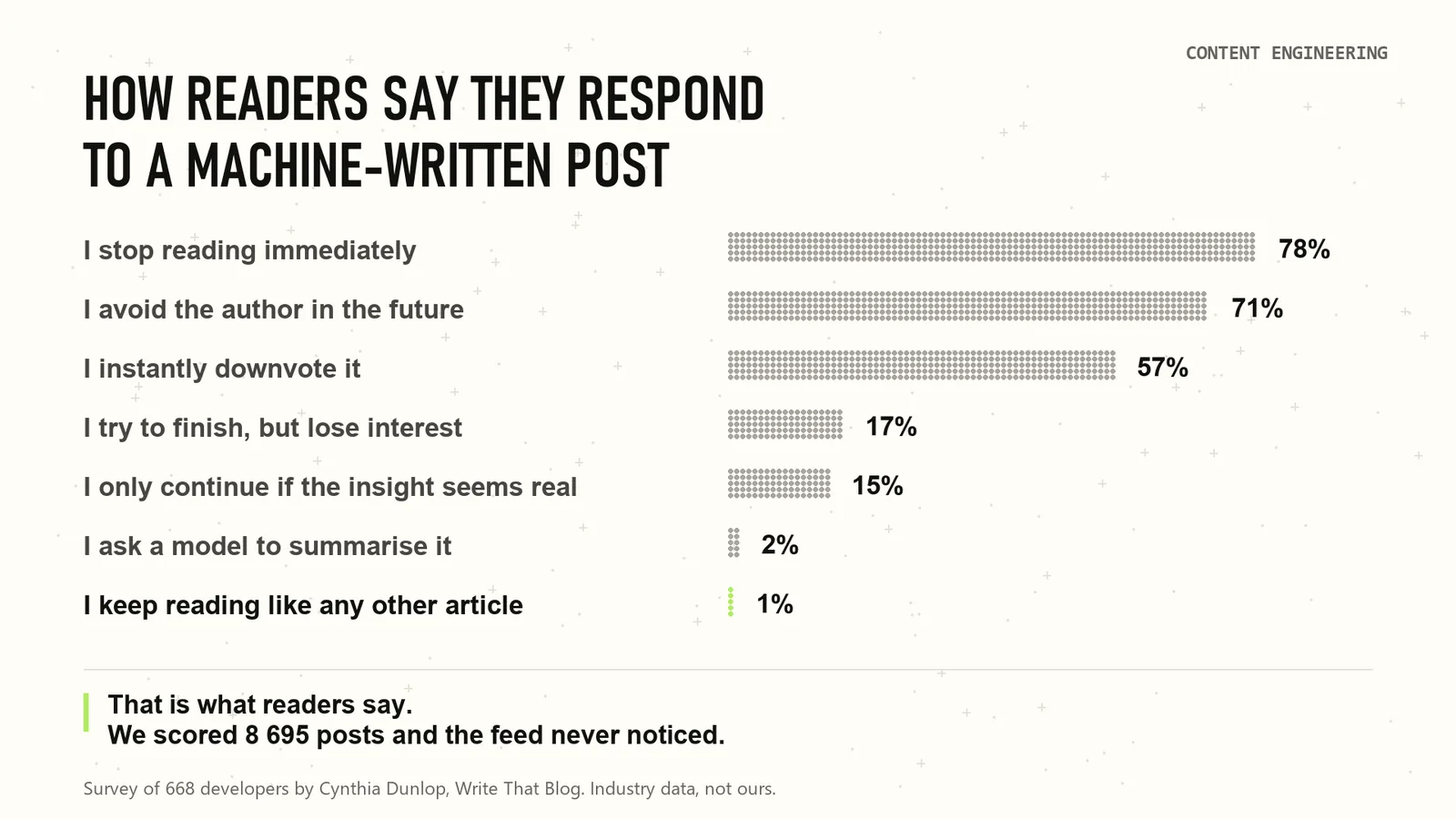
Cantrill builds on a survey by Cynthia Dunlop, who runs the Write That Blog newsletter about technical blogging. She asked 668 developers what they do when they believe a piece was written by a model:
- 78% stop reading immediately
- 71% avoid that author in the future
- 57% downvote it on the spot where the platform allows
- 17% try to finish and lose interest, 15% keep going only if the insight seems real
- 1.2% keep reading like it was any other article
- 98% would rather read an author's own imperfect writing than a polished machine version
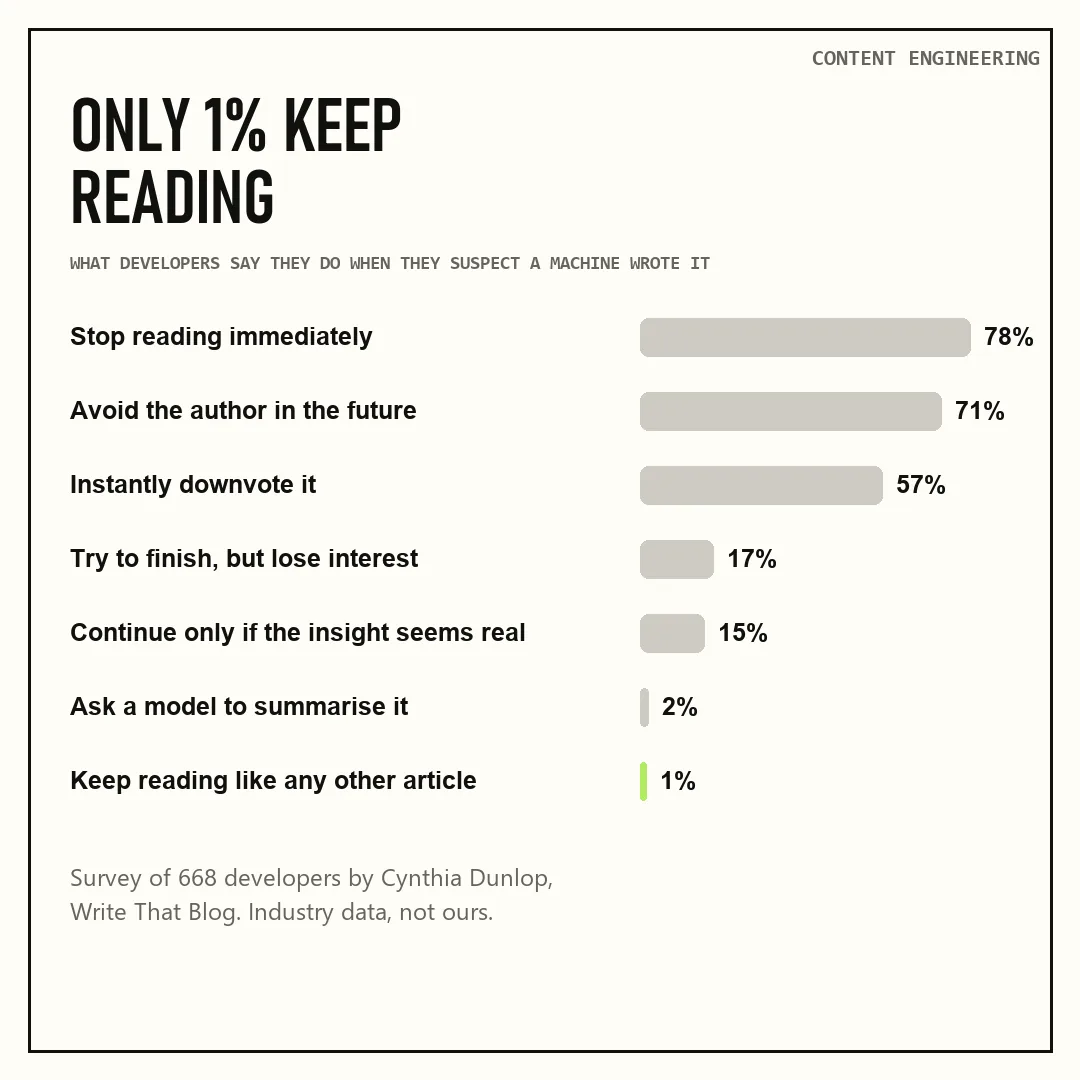
Survey of 668 developers by Cynthia Dunlop. Industry data, not ours.
Start from the bottom of that list. Barely one reader in a hundred carries on as though nothing happened. Whatever else is arguable here, indifference is not an option people claim for themselves.
That second number is the one with teeth. They do not bail on the article, they write off the person. It is a withdrawal of attention that compounds over months, and it is exactly the kind of damage a founder never watches happen.
Cantrill then reaches for an analogy that lands harder than the survey. He compares this moment to email spam in the early 2000s. For years the economics of spam worked because nothing stopped it. Then filtering got good, and being labeled a spammer became expensive enough that legitimate companies stayed far away from bulk email, because the cost was your domain and your brand. His read is that machine writing follows the same arc. Detection improves, and the label starts to cost something.
We publish on LinkedIn every week and build content systems for other companies, and we had never measured any of this on our own ground. If there is a price for machine-shaped writing, it should show up in our numbers before it shows up in our feelings.
One caveat before the data, and it matters for everything below. Cantrill writes about long technical articles, where a reader commits twenty minutes on purpose. We are looking at a feed. Those are different rooms, and I wanted to know what the second one looks like.
How we measured
The method is deliberately boring, and every step of it is repeatable by you:
- The population. Our system tracks 85 437 LinkedIn authors and 840 818 posts. Between August 8 and September 7, 12 744 of those authors published at least once.
- The sample. A random draw from those active authors, then every post each of them published inside the window: 10 005 posts from 1 635 people.
- The cleaning. Anything under twenty words was dropped, because a sentence and a link tells you nothing about a writing style. That left 8 695 posts from 1 463 authors.
- The ruler. We did not invent one. We already publish an open list of machine-writing markers as part of our LinkedIn skills on GitHub, in the humanizer skill, which about 1 200 people have installed. Twenty patterns in total: vocabulary models overuse, phrase shapes they fall into, punctuation habits, and structural tells like stacked short fragments.
- The scoring. Our script does not retype those patterns. It executes the code block straight out of the published file, so the method behind every number here is a file you can download and run against your own last thirty days.
Two definitions matter. A post carries a marker when any single pattern fires. A post is flagged when it hits one of the patterns strong enough to stand alone, or when three markers pile into a single paragraph. Those are very different bars, and the gap between them turns out to be a finding of its own.
Two honest notes. A marker is not proof that a model wrote something: people write "significant" and "robust" too, and people stack fragments for rhythm. What we measure is machine-shaped writing, not machine authorship, and nobody can measure the second one with certainty, including the companies selling detectors. And we sell content systems, so we walked in with a preferred answer. The one we got was not it.
Finding one: less machine text than the mood suggests
14.2% of posts are flagged. Turned around, roughly six posts in seven read clean by our own standard.
The distribution underneath that number is more interesting than the number:
- 48.8% of posts contain no marker at all, not even one word from the list
- 51.2% contain at least one, which is the difference between using a word and having a signature
- 32.8% contain two or more, 26.4% contain three or more
- 16.7% contain five or more, and 5.7% contain ten or more
- the heaviest single post in the sample carried 156 markers
This is where the two thresholds from the method section start to matter. Half the feed uses at least one word from the list, and only 14.2% of it carries an actual signature. The gap between those two numbers is the whole problem with AI detection: most of what the list flags is simply English, and a tool that treats one word as a verdict will accuse half of LinkedIn of being a robot.
Look at people instead of posts and it sharpens further. 69.8% of authors, more than a thousand of them, went a full month without a single flagged post. Only 3.1% had markers in everything they published. Among the 620 authors who published four or more times, just 34 had half or more of their posts flagged.
So the machine-shaped writing on LinkedIn is not evenly spread mist. It is concentrated in a small number of accounts producing a lot of it.
Finding two: the cleanest writers are the smallest accounts
This one runs backwards from what you would guess.
- under 5 000 followers: 10% of posts flagged
- 5 000 to 20 000: 14.7%
- 20 000 to 100 000: 16%
- above 100 000: 15.8%
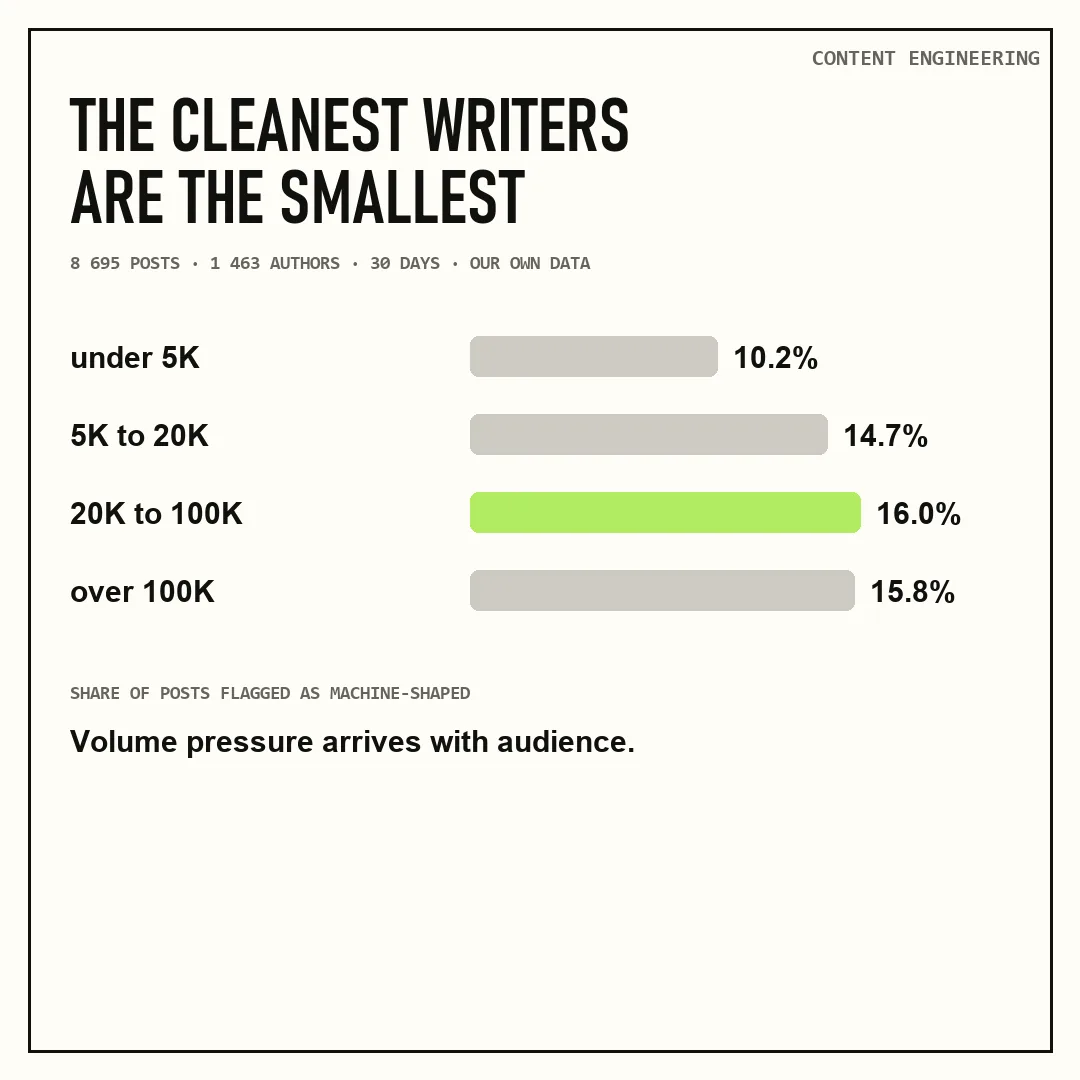
The cleanest writers on LinkedIn are the smallest accounts. Our own data, 8 695 posts.
The explanation is not mysterious. A person with nine hundred followers writes when they have something to say. A person with sixty thousand has a cadence to keep, often a team, sometimes an agency, and a calendar that does not care whether this week produced an idea. Volume pressure is what pulls text toward the machine, and volume pressure arrives with audience.
If you want one diagnostic from this whole issue, it is that. The marker is a symptom. The disease is publishing more often than you think.
Finding three: we looked for the price in three places and found none
If the survey describes how people behave, flagged posts should underperform. Not dramatically, but visibly.
Across the sample they did the opposite. Flagged posts sat at the 54th percentile of engagement, clean posts at the 48th. Median engagement was 29 against 24.
The obvious objection is that different people write differently, and comparing my posts to yours mostly measures the distance between our audiences. So we compared every author against themselves, their flagged posts against their own clean ones. Among the 175 authors with enough of both, the median difference was 9% in favor of the flagged posts, and fewer than half saw their flagged posts do worse than their own clean ones.
The second objection is length, since longer posts have more room to collect markers. So we checked inside bands of similar length on our control slice of 253 accounts above 100 000 followers. Under 100 words: 105 median engagements clean against 180 flagged. From 100 to 200 words: 184 against 248. From 200 to 350: 233 against 295. Above 350: 238 against 245. The pattern holds in all four bands, so length does not explain it.
The third objection is the survey's actual claim, and the one I cared about. "I avoid the author in the future" is a delayed penalty that would never appear on a single post. It would appear as a person whose audience slowly stops arriving.
So we looked at authors. For 613 authors with enough posts and a real audience, we compared how much of their writing carried markers against their engagement per thousand followers. The rank correlation came out at minus 0.06, which in plain language means no relationship. Inside bands of similar audience size the differences ran in both directions on groups of thirty to forty people, which is what noise looks like.
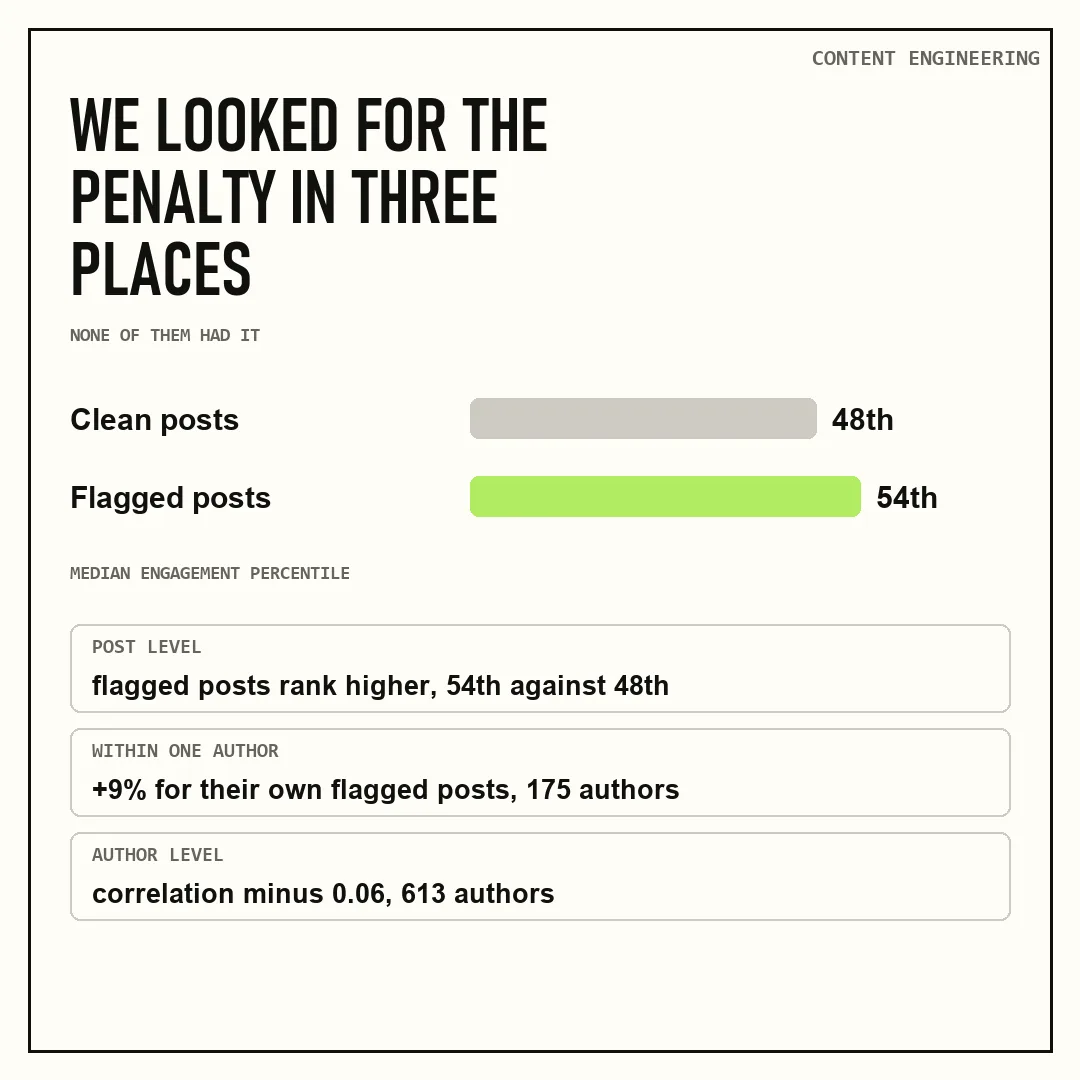
We checked at post level, inside each author, and across authors. None of the three showed a penalty.
Finding four: the habits everyone hunts cost nothing
If the average is null, the useful question is whether any specific habit carries a cost on its own.
We tested all sixteen markers that appeared often enough to test, comparing each author against themselves, and ran a sign test so we would report evidence rather than impressions.
Four came back statistically significant, and every one of them points up:
- stacked short fragments, the trick of breaking a thought into three-word lines: about +14% across 329 authors
- the old 2023 vocabulary: +26% across 150 authors
- the double dash between clauses: +26% across 63 authors
- the sentence-opening "-ing" clause that every style guide warns against: +14% across 215 authors
The other twelve landed in the noise, including the corporate vocabulary everyone treats as the giveaway. Not one of the sixteen is associated with a drop.
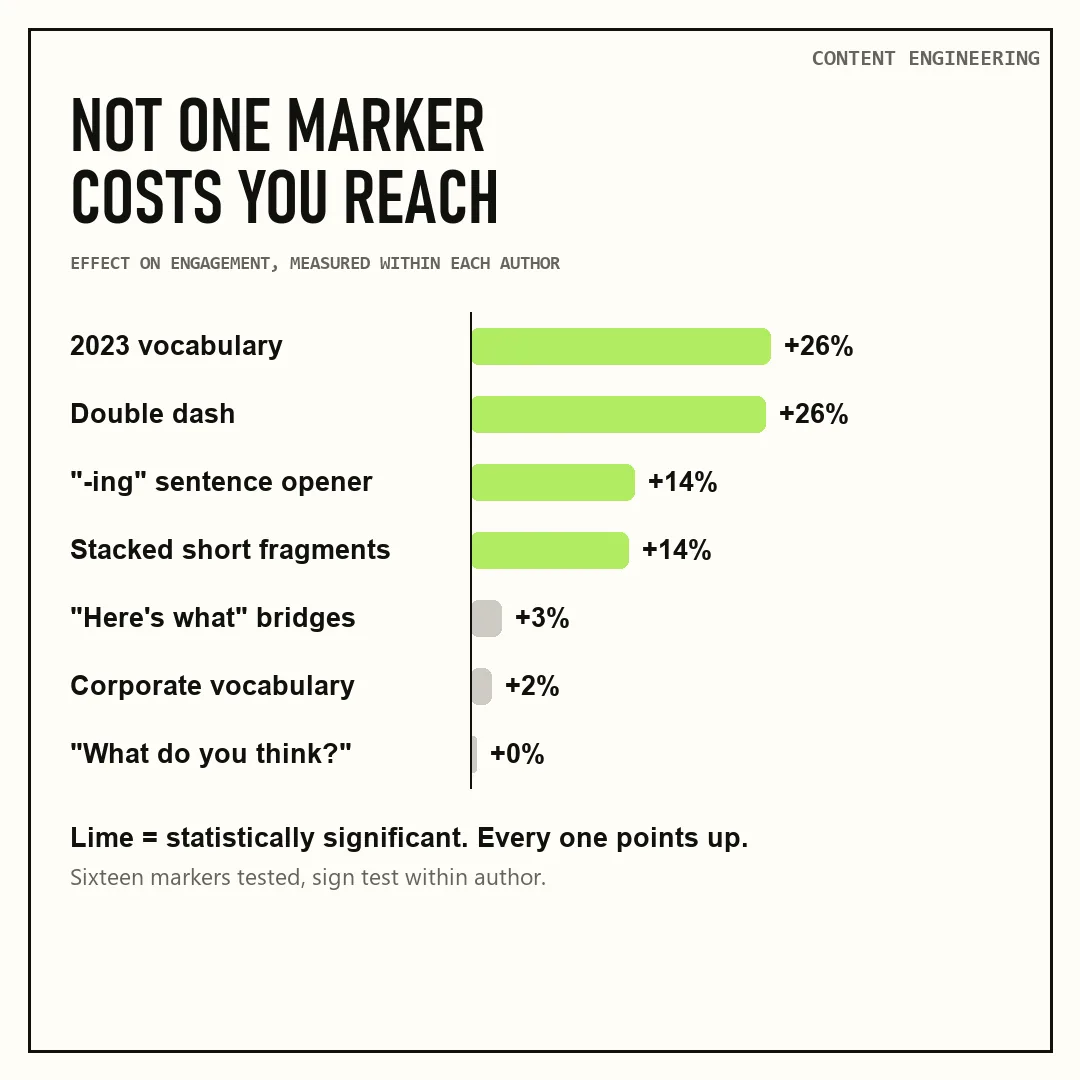
Effect measured within each author. Lime marks the statistically significant results, and all of them point up.
Now the caution, because this is where a finding becomes a lie if you let it. We ran sixteen tests at a 5% threshold, so roughly one significant result is expected by chance alone. Under a strict correction, only the first line survives with confidence. And correlation is not causation, which matters enormously here: "journey" and stacked fragments are the native vocabulary of personal storytelling, and personal storytelling performs well on LinkedIn for reasons that have nothing to do with who typed it. The marker may be a symptom of the genre rather than a cause of anything.
What survives is a negative result, and negative results are the honest kind.
A bonus myth, while we had the data open
Since we had every post's body text, we checked the other rule everyone repeats: that a link in the post kills your reach.
22.8% of posts in our sample carry a link in the body. Their median engagement was 27. Posts without a link had a median of 23.
Posts with links also came back flagged more often, 17.5% against 13.2%, which fits the picture from Finding two: link-in-post is a promotion habit, promotion runs on a calendar, and calendars are what pull text toward the machine.
We are not going to claim links help. What we can say is that in a month of the platform, at this sample size, the collapse everyone warns about did not appear.
The vocabulary of machine LinkedIn, 2026 edition
Here is the part I did not expect, and the part you can use tomorrow.
The words everyone still hunts for are gone. In 8 695 posts, "delve" appeared exactly once. "Tapestry" once. "Intricate" twice. "Paradigm" eight times. "Realm" six. The entire 2023 vocabulary that became shorthand for machine text has been scrubbed out of the platform, presumably by the same people writing about how to spot it.
What actually shows up now is a different register, and it does not sound like a robot at all:
- "the work" in 500 posts, 5.8% of the sample, 598 occurrences, the single most common marker phrase
- "journey" in 304 posts, 3.5%, the one 2023 word that survived
- "quietly" in 276 posts, 3.2%, as in quietly building, quietly shipping
- "insights" and "insight" in 323 posts, 3.7%
- "ecosystem" 147 times, the "leverage" family 182, "navigate" and its forms 199
- "compound", "compounds", "compounding" 181 times combined
And the phrase layer, which is even more familiar:
- "Here's what" 141 times, plus "Here's how" 47 and "Here's why" 22
- "What do you think?" 69 times, and "Let me know in the comments" 32
- "Have you ever" 39, "Here's the thing" 18, "Thoughts?" 15
- "The result?" three times, which tells you that particular tell is already dead
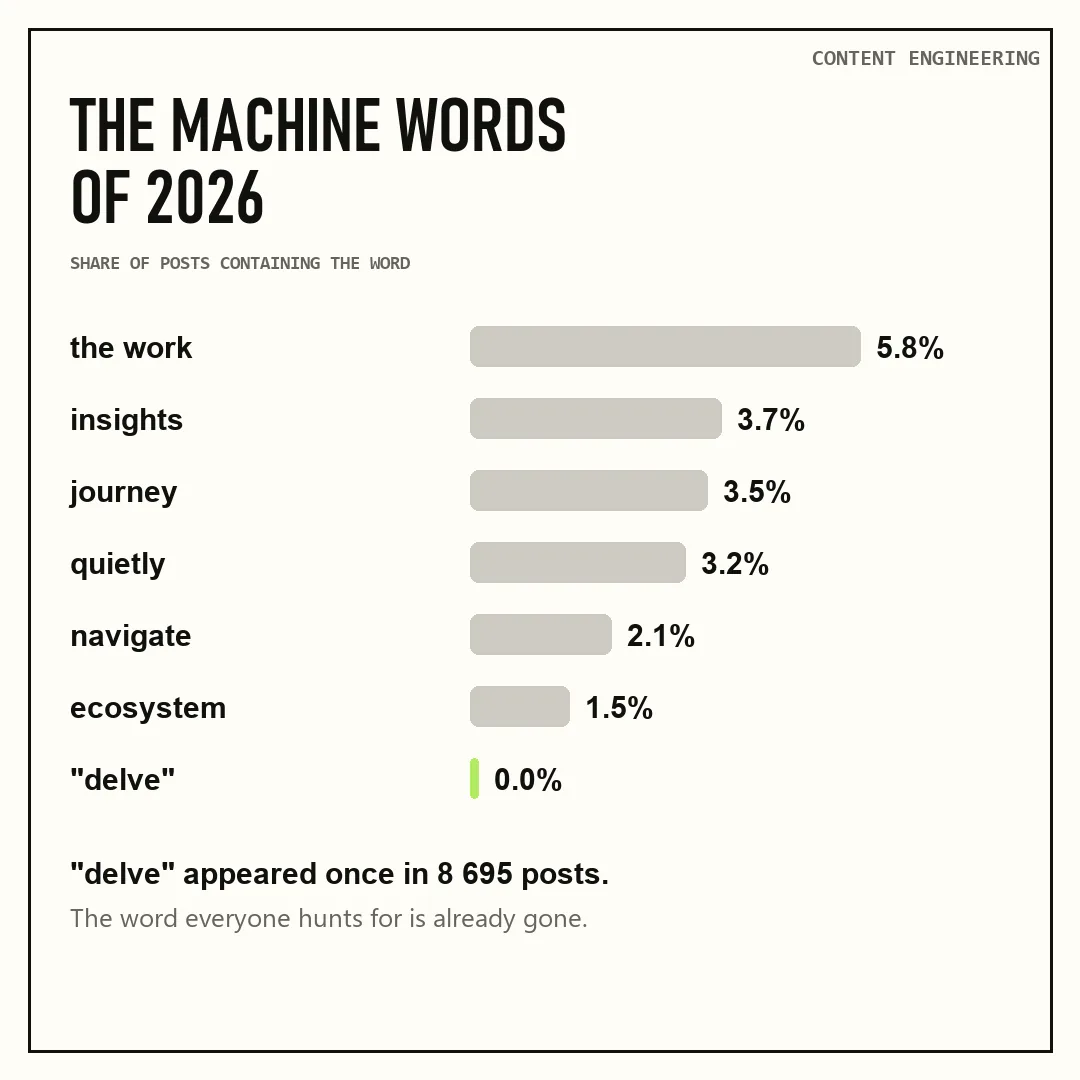
The word everyone still hunts for appeared once in 8 695 posts. The words that replaced it look ordinary.
Read that list again. Not one of those words is exotic. This is the vocabulary of competent LinkedIn writing, which is exactly why detection is so hard and why every off-the-shelf detector is guessing. The machine register in 2026 is not purple prose. It is a slightly too even, slightly too tidy version of how a good writer already sounds.
Why both things can be true
I do not read our numbers as an argument against Cantrill. I read them as a map of where his point applies and where the instruments cannot see it.
The rooms are different, and so are the stakes. Dunlop surveyed subscribers to a newsletter about how to write blogs, close to the most writing-sensitive population on earth, reading long technical articles by choice. Twenty minutes on an article is an investment, and finding out halfway through that nobody thought about the sentences is a real loss. LinkedIn is a feed, the median reader arrived by scrolling, and three seconds costs nothing. You cannot feel betrayed by something you were barely reading, which is also why the same person answers a survey with principle and then taps through the feed without it.
And the metric does not measure the thing. A like is not trust. "I avoid the author in the future" describes someone who stops opening your posts, stops replying, stops thinking of you when a budget appears. There is no counter under a post for any of that. Engagement reports the reaction of the people who stayed, and it is blind by design to everyone who stopped showing up. The survey and our data are not measuring the same thing, and only one of them has a number attached.
Which brings back the spam analogy, and it may be the sharpest thing in his piece. Spam was not free because it was harmless. It was free because detection did not exist yet. Once filters got good, the label started costing companies their domains.
By that clock, machine-shaped writing on LinkedIn is somewhere around 2003. No filter, no label, no consequence. Our 14.2% is a snapshot of the world before the filter, and the whole argument for cleaning your text today rests on believing the filter is coming.
What we changed
Two things, and neither is what our data would suggest if you read it lazily.
We stopped selling the humanizer pass as a reach tactic. It was written into our internal rules that machine text costs 30% of reach and 55% of engagement. That claim circulates everywhere, we repeated it, and we could not reproduce it across a month of the platform. So we deleted it. Making a false promise about the algorithm to justify a real practice is how you end up with a team that stops believing any of your rules.
We kept the humanizer pass, with its reason moved to where it belongs. You clean your text because a specific person is going to read it, and because 98% of the readers in that survey would rather have your imperfect sentences than a polished machine version. That is not a reach argument. It is the same argument as showing up on time.
The practical version:
- Do not chase the word list. Most of it costs nothing, and rewriting your voice to satisfy a regular expression is its own kind of machine writing.
- Do watch what sits underneath it. The spike between 20 000 and 100 000 followers is not a vocabulary problem, it is volume running ahead of thinking.
- Write the post yourself when you have something to say, and publish less often when you do not.
- If a model helped, rewrite the sentences until they are yours before anyone reads them.
Run this on your own posts
Everything above came out of a tool we give away, and you can reproduce the whole issue on your own account in about ten minutes.
It lives at github.com/sergebulaev/linkedin-skills, a set of eleven LinkedIn skills for Claude Code that around 1 200 people have installed. Two of them did the work in this issue:
- linkedin-humanizer holds the marker list itself, the same file our scoring script executed. It runs three passes over a draft: it strips the tells, restores sentence rhythm where the text went machine-flat, and removes the performed hesitancy that models add on their own, the "let me be honest" openers that show up twice as often in generated text as in human writing.
- post-audit, which sits inside it, scores a finished draft before you publish and tells you which patterns fired and why.
The list is versioned and dated, currently V3 from September 2026, because the vocabulary moves. This issue is the evidence for that: a list written in 2023 would still be hunting for "delve" and would miss "the work" entirely.
Two ways to use it that we actually use ourselves. Point it at your last thirty days and get your own percentage rather than trusting ours, which takes one pass and usually produces one uncomfortable surprise. And put it at the end of your drafting process rather than the start, because running it before the thinking is done just produces cleaner filler.
It is free, it runs locally, nothing leaves your machine, and you can read every pattern before you trust it.
Then decide what you think your number will be worth in 2027.
Sources
- Bryan Cantrill, "The Revolt of the Reader", September 5, 2026, the piece that prompted this issue
- Cynthia Dunlop, "How developers react to AI-written blog posts", Write That Blog, the survey of 668 developers quoted above
- github.com/sergebulaev/linkedin-skills, the humanizer skill and the marker list our scoring ran on, V3, September 2026
- Our own measurement: 8 695 posts published between August 8 and September 7, 2026 by a random sample of 1 463 LinkedIn authors, drawn from the 12 744 who published in that window. Control slice: 3 711 posts from 253 accounts above 100 000 followers
Content Engineering is a newsletter by cccrafts. We build and run content systems for B2B companies. Questions or data requests: Serge on LinkedIn.
Serge Bulaev is the CEO and founder of cccrafts, where the team builds and runs content systems for B2B companies. He writes Content Engineering, a newsletter about the data, automations and costs behind content that reaches the right buyers.