
Does Follower Count Still Matter on LinkedIn in 2026?
Every founder runs the same math: I have 2,000 followers, the people I read have 200,000, why bother? We measured 64,092 posts by 4,677 B2B authors over 30 days. The answer has two layers, and both change what a small account should do this week.

Does Follower Count Still Matter on LinkedIn in 2026?
Every founder who considers posting on LinkedIn runs the same math: "I have 2,000 followers. The people I read have 200,000. Why bother?" We put that math to the test. Our system tracked 64,092 posts published in the last 30 days by 4,677 business authors, including 1,703 founders, and measured who breaks out and who does not. The answer has two layers, and both of them change what a small account should do this week.
Ask a founder why they stopped posting on LinkedIn and you rarely hear "I ran out of things to say." You hear a number. "I posted for two months and got 11 likes." The follower count feels like a verdict: the big accounts play a different game, and until you have their audience, publishing is theater.
The advice industry answers this with slogans. One camp says reach is dead and follower count means nothing since LinkedIn rebuilt its feed around content relevance. The other camp sells audience growth as the only metric that matters. Both camps quote anecdotes, no one shows a base rate.
We sell content systems to B2B companies, so we have a horse in this race and a database to check it against. Our system tracks around 61,000 B2B authors on LinkedIn and stores every post they publish, currently 772,000 posts and counting. Founders are the audience we serve and study, so this issue measures them specifically. What follows is our own data, not a LinkedIn press release.
In this article
- If you only have 60 seconds
- How we measured breakouts
- Small accounts break out more often
- Size converts tickets into prizes
- The bigger the audience, the deeper it sleeps
- What small founder accounts break out with
- Twelve founders under 20K who broke out
- Frequency multiplies the odds
- The Playbook: raise your own breakout rate
- Closing
If you only have 60 seconds
- We measured 64,092 posts from 4,677 B2B authors over 30 days, 1,703 of them founders. Our own data.
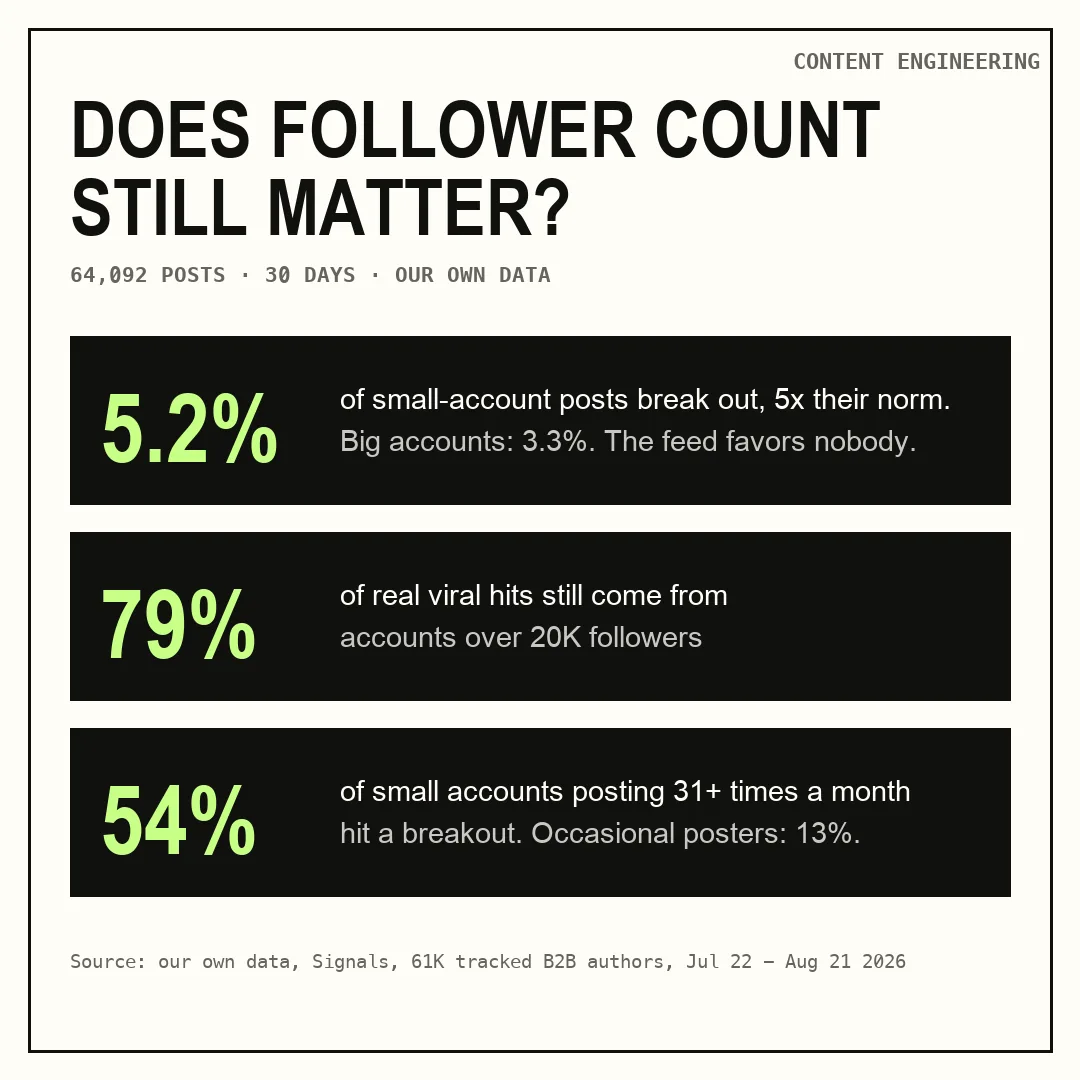
- Small accounts break out more often. 5.2 percent of posts from 1-5K accounts jump to five times their author's baseline, against 3.3 percent for accounts above 100K.
- Large accounts convert those jumps into volume. Accounts above 20,000 followers own 79 percent of all viral hits, meaning breakouts that also clear 200 engagements.
- Median engagement rate falls almost tenfold as accounts grow, from 0.44 percent under 1K to 0.048 percent above 100K. Most of a huge audience is inventory, not attention.
- Frequency is the lever a founder controls. Among accounts under 20K, 12.6 percent of those posting 1-4 times a month had a breakout, against 54.2 percent of those posting 31 times or more.
- Not a single account under 20K went viral on filler. Stories with specifics, numbers that surprise, or news that is big and true. A playbook is at the end.
64,092 posts, 30 days, three numbers
How we measured breakouts
"Going viral" needs a definition before it can be counted. A post with 500 reactions is a slow Tuesday for an account with a million followers and a life event for an account with three thousand. So we measured virality relative to each author's own baseline.
Here is the full method in five lines:
- We took every post published between July 22 and August 21, 2026 by authors our system tracks, the same base we used for our own pipeline experiment: 64,092 posts after cleaning, from 4,677 authors.
- For each author we computed a baseline: their typical engagement per post, where engagement means reactions plus comments plus reposts.
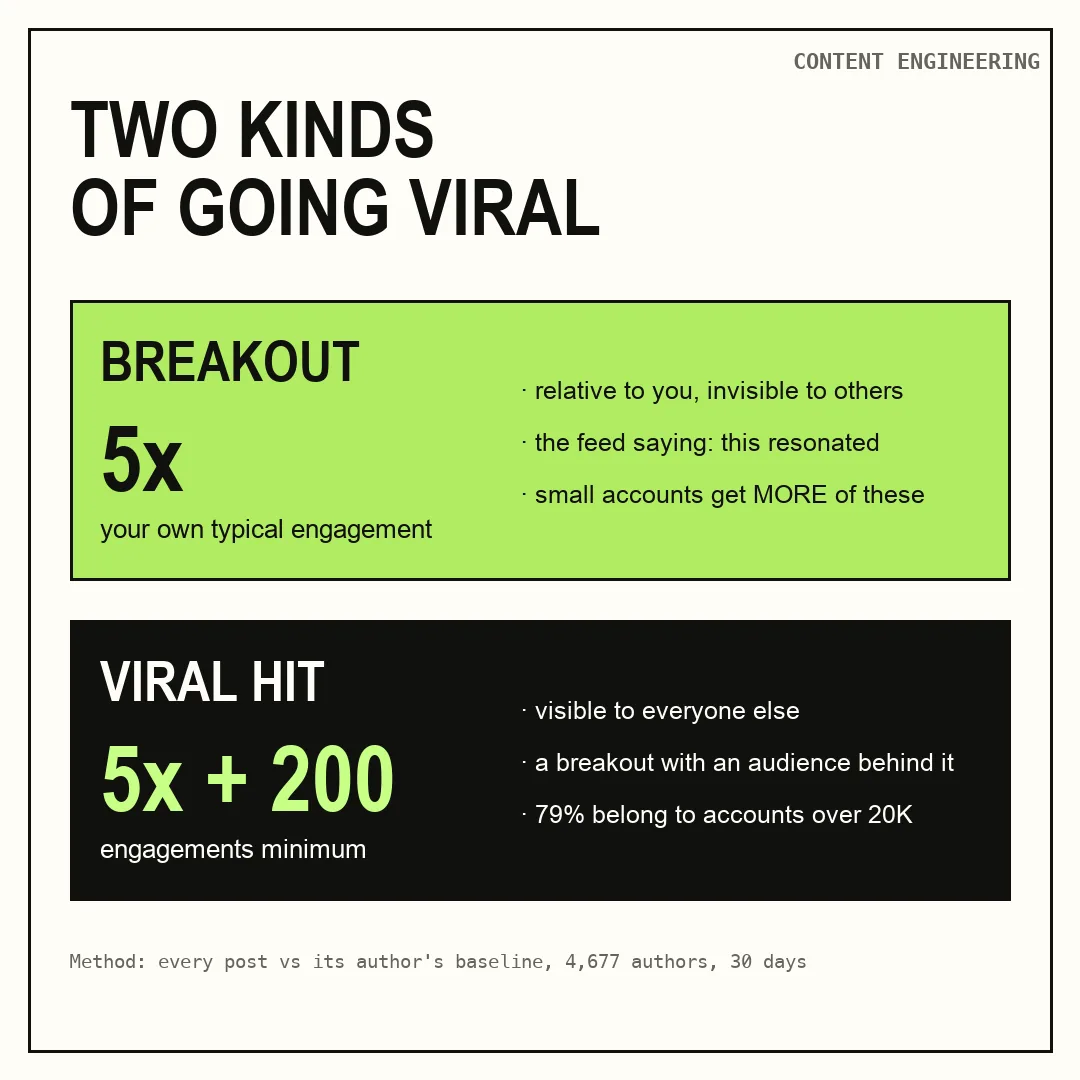
- A post counts as a breakout when it earns at least 5 times its author's baseline.
- A post counts as a viral hit when it is a breakout and clears 200 total engagements, so a jump from 2 likes to 11 does not count as fame.
- We grouped authors into five size buckets, from under 1,000 followers to over 100,000, and compared the buckets.
One cleaning step matters enough to mention: 2.5 percent of the posts in the window were reposts wearing the original post's engagement numbers. A 3,000-follower account "going viral" with 3,700 reactions turned out to be sharing a celebrity's post. We removed every case where the post URL did not belong to the author. If you have ever seen a tiny account with impossible numbers, this is often the trick behind it.
Two definitions, two different stories: a breakout is relative to you, a viral hit is visible to everyone else
Small accounts break out more often
Start with breakouts, the purely relative measure. What share of posts jump to 5 times their author's normal engagement?
| Account size | Posts measured | Share that broke out |
|---|---|---|
| Under 1K followers | 716 | 4.3% |
| 1-5K | 6,586 | 5.2% |
| 5-20K | 16,245 | 4.6% |
| 20-100K | 27,264 | 3.1% |
| 100K+ | 13,281 | 3.3% |
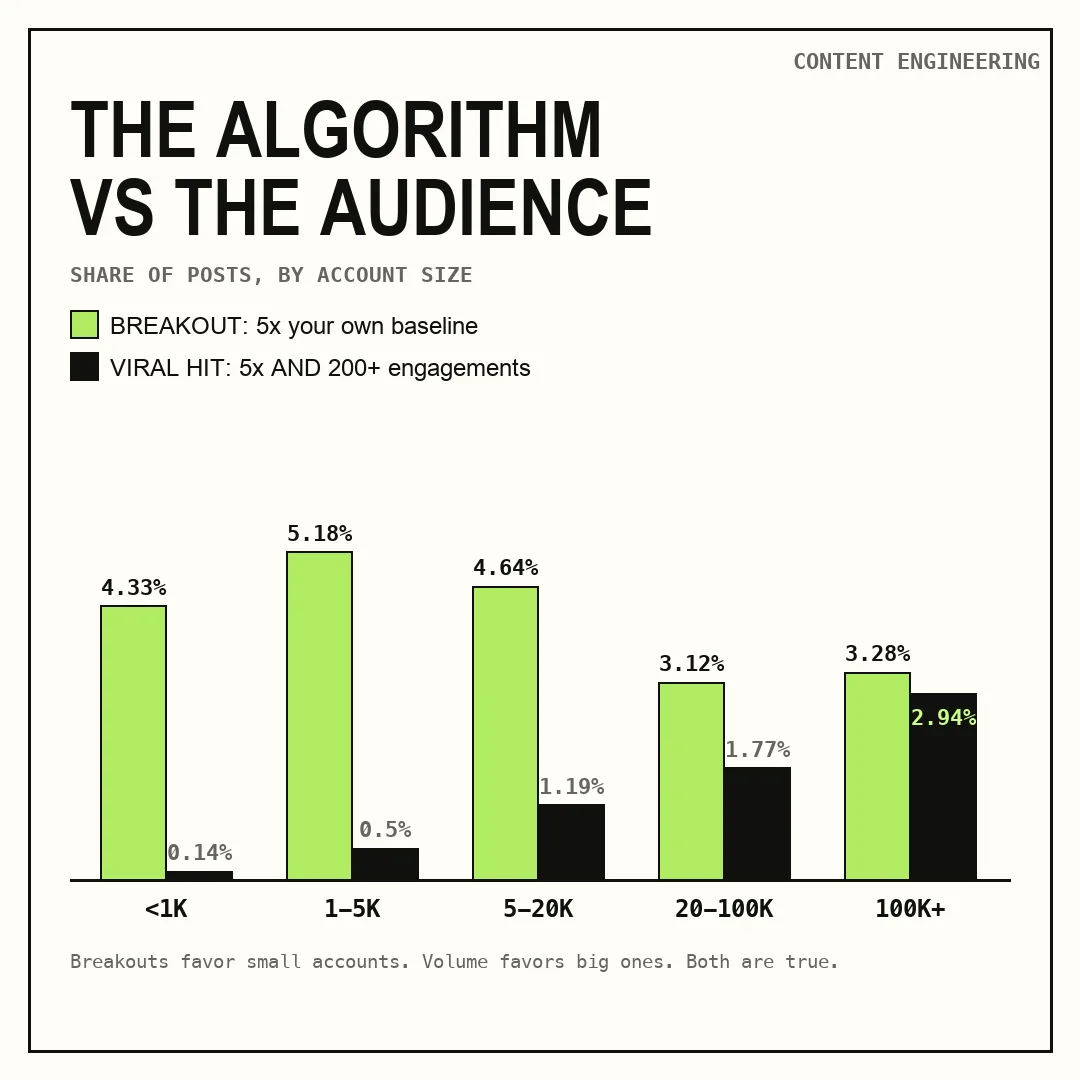
Read those numbers twice. Small accounts break out more often than large ones. An author with 3,000 followers has roughly one post in twenty jump far above their normal numbers. An author with half a million followers has one in thirty. Founders specifically show the same shape: 4.7 to 4.8 percent breakout rates below 20K followers, dropping to about 3 percent above it.
This is the part of the "follower count is dead" story that survives contact with data. The feed genuinely tests content on its own merits. Every post gets shown to a slice of people beyond your followers, and when that slice reacts, distribution expands regardless of who you are. Large accounts sit closer to their ceiling; their baseline already includes the algorithm's favor, so multiplying it by five is harder.
If you have a small account and one of your posts suddenly did 10 times your usual numbers, that was not luck malfunctioning. That was the machine working as designed.
Size converts tickets into prizes
Now add the second condition, the 200-engagement floor that separates a private spike from a public event.
| Account size | Share that became a viral hit | Roughly one post in |
|---|---|---|
| Under 1K followers | 0.14% | 714 |
| 1-5K | 0.50% | 200 |
| 5-20K | 1.19% | 84 |
| 20-100K | 1.77% | 56 |
| 100K+ | 2.94% | 34 |
The gradient flips. Accounts above 20,000 followers produce 79 percent of all viral hits in our data, from just under two thirds of the posts. A 1-5K account converts a post into a real viral hit once in 200 attempts; a 100K+ account, once in 34.
Put both findings side by side and the honest answer to the headline question appears:
The algorithm gives small accounts more breakouts. The audience gives large accounts more reach. A breakout on 2,000 followers is 5 times almost nothing.
So does follower count still matter? For getting the feed's attention, less than the pessimists claim. For turning that attention into volume, as much as it ever did. Anyone who tells you only one of these things is misquoting half of the data.
Breakout rate falls as accounts grow. Viral hit rate rises. Both lines are true at once
The bigger the audience, the deeper it sleeps
There is a consolation prize hiding in the data, and it is bigger than it looks.
Median engagement rate, meaning the typical post's engagement divided by the author's follower count, falls almost tenfold as accounts grow. Our numbers: 0.44 percent for accounts under 1K, 0.21 percent at 1-5K, down to 0.048 percent at 100K+.
In plain terms: a 2,000-follower founder typically activates one in every 500 followers per post. A 500,000-follower author activates one in 2,000. Most of a huge audience is inventory, not attention. This is also the sobering half of the founder's math: the median post by a 1-5K founder in our window earned 7 engagements. The median post by a 100K+ founder earned 136. Neither number is fame. The feed distributes moments; the baseline stays humble at every size until the system around the content raises it.
We saw this exact mechanic from the company side in our comparison of 107 founders with their own company pages, where founders out-performed those pages seven to one. Same lesson, different scale: attention follows density of relationship, not size of the room.
What small founder accounts break out with
The size question settled, the content question remains: when a founder with a small account does land a viral hit, what did they post? We read all 385 viral founder posts from the window and sorted them into themes. Rough shares, our own classification:
- Personal stories and vulnerable moments, about 30 percent. Origin arcs, failures, family, health, career turns.
- Company news with real numbers, about 20 percent. Funding rounds, revenue milestones, launches, named customers.
- Leadership and management essays, about 15 percent.
- AI takes, about 13 percent. Agents, costs, tools, contrarian positions.
- Playbooks and data breakdowns, about 10 percent. Specific numbers, specific steps.
- Career and hiring, about 8 percent. The rest is humor and short quips.
The distribution hides the most useful fact we found. The humor and near-empty posts that go viral belong almost exclusively to huge accounts. A 2.9-million-follower author in our window collected 1,670 engagements on a post whose full text was "ha ha". Not one account under 20K followers went viral without substance: a story with specifics, a number that surprises, or news that is simply true and big.
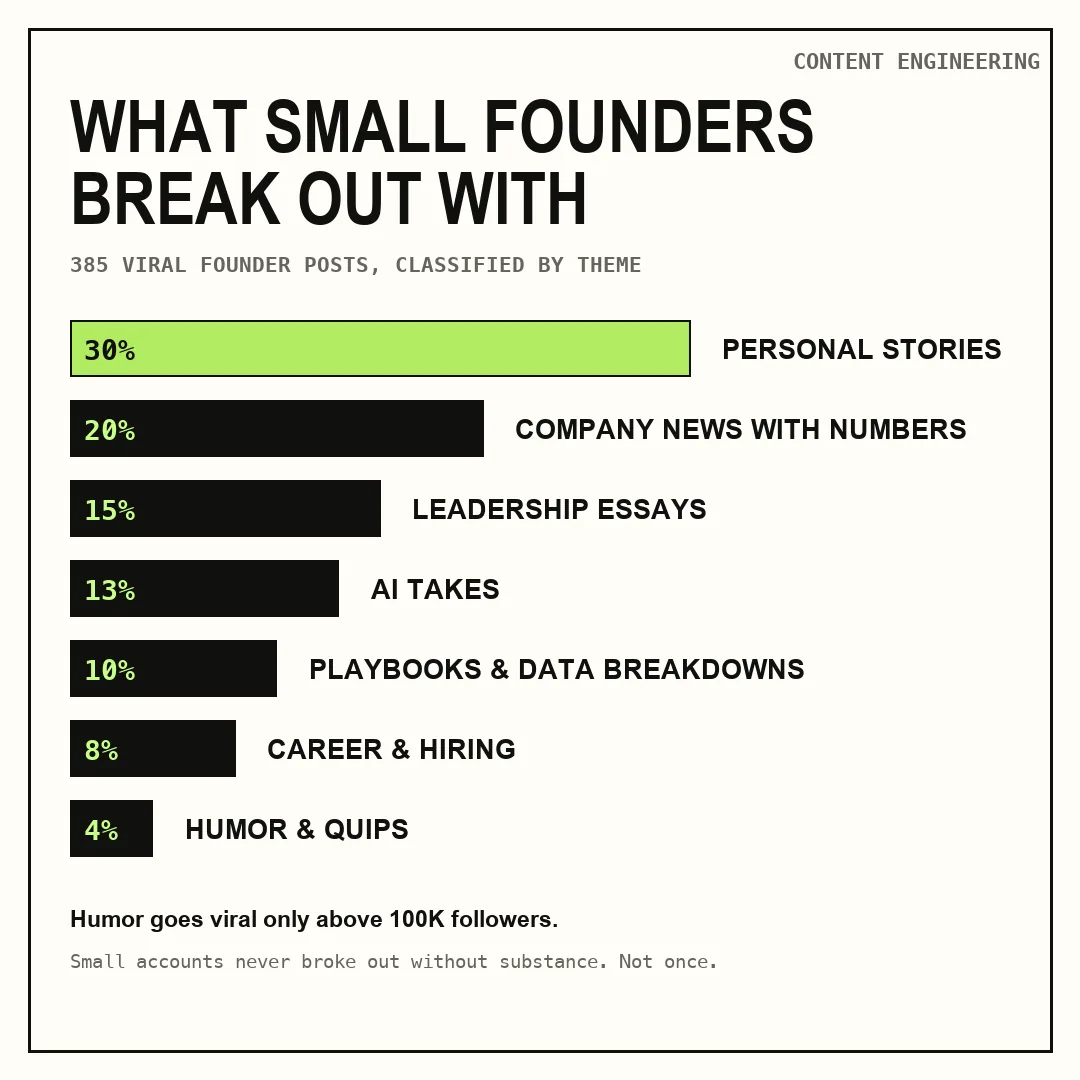
What breaks out from small founder accounts: stories, numbers, and news. Never filler
Twelve founders under 20K who broke out
Here are founders from our data who did it in the last 30 days, with follower counts at the time of posting. Every name links to the actual post.
| Founder | Company | Followers | Engagements | vs baseline | What worked |
|---|---|---|---|---|---|
| Caelean Barnes | Gauge | 6.5K | 1,701 | ×95 | A $2M ARR milestone with the numbers behind it |
| Ilan Zerbib | Sapiom | 6.1K | 1,034 | ×45 | An eleven-month timeline from founding to launch |
| Borys Ulanenko | ArmsLength AI | 19.9K | 850 | ×283 | A niche finance explainer on intercompany funding |
| Ashwin Gopinath | Sentra | 15.1K | 668 | ×26 | Walking away from an MIT professorship |
| Haris Husejnovic | ZenDev | 9.7K | 627 | ×45 | A story about his mother at the window |
| Matteo Fois | Kinetyca | 9.8K | 567 | ×16 | A playbook: the first three go-to-market hires |
| Brett Harrison | Architect | 4.9K | 548 | ×9 | An engineering story from Jane Street |
| Stephanie Curcio | NLPatent | 9.6K | 411 | ×13 | A months-kept secret, finally announced |
| Evaldas Bieliūnas | Guideless | 4.0K | 385 | ×17 | A €1M pre-seed announcement |
| Michele Hansen | Geocodio | 2.9K | 237 | ×14 | A hiring story that showed the company's values |
| Nataliya Anon | Svitla Systems | 2.0K | 232 | ×26 | A contrarian question about AI spend |
| Yahia Bakour | Context.dev | 4.4K | 217 | ×14 | One line: "We've officially launched on YC!" |
Twelve founders, all under 20,000 followers, all in the last 30 days. None of them needed an audience first. They needed one post where the substance was undeniable.
Frequency multiplies the odds
The two answers above still leave a founder with a practical unknown: how much does trying more often change the odds? We grouped every author by how many posts they published in the 30-day window and checked what share of each group landed at least one breakout that month. Our own data again:
| Posts in 30 days | Authors with a breakout | Authors with a viral hit | Under 20K: breakout |
|---|---|---|---|
| 1-4 posts | 12.8% | 7.7% | 12.6% |
| 5-8 posts | 21.8% | 7.0% | 25.4% |
| 9-15 posts | 29.0% | 12.8% | 36.2% |
| 16-30 posts | 37.6% | 22.1% | 41.5% |
| 31+ posts | 46.5% | 28.8% | 54.2% |
For accounts under 20,000 followers the effect is even sharper: 12.6 percent of occasional posters had a breakout month, against 54.2 percent of those who published 31 times or more. The share with a genuine viral hit tripled, from 5 percent to 14.5 percent. This is a correlation, and prolific posters are probably also more practiced. But the direction is hard to argue with: a breakout is a per-post probability, and the authors who show up most often collect the most draws.
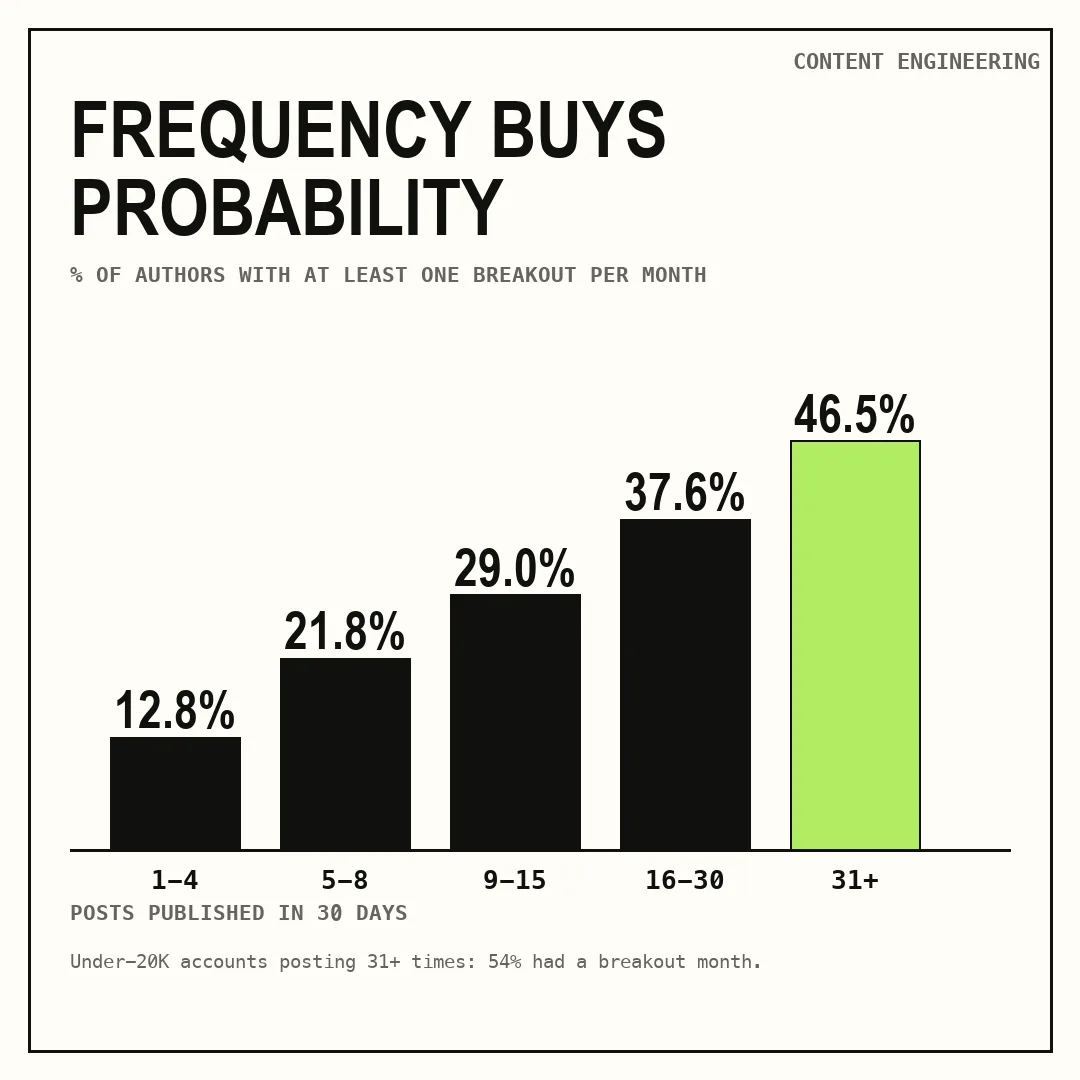
Chance of at least one breakout in a month, by posting volume. Frequency compounds probability
The Playbook: raise your own breakout rate
Everything above collapses into five moves a founder can make this month, without buying an audience first.
- Write down your baseline. Take your last 30 days of posts, add reactions, comments and reposts, take the median. That single number is what a breakout gets multiplied by. Until you know it, every result feels random.
- Count your draws, then raise the count. Four posts a month put you in the 12.6 percent group. Nine to fifteen put you in the 36 percent group. This is the one variable you fully control, and it moves the odds more than anything else we measured.
- Never spend a draw on filler. Zero accounts under 20K went viral on a quip in our window. A post qualifies when it carries a story with specifics, a number that surprises, or news that is big and true. Everything else is a wasted ticket.
- Stock the three themes that actually break out. Half of all viral founder posts are personal stories and company news with numbers. Keep a running list of both: the milestones ahead of you, and the turns behind you that you have never written down.
- Judge yourself on rate, not on follower count. Track breakouts per month and the conversations they started. Followers are the multiplier that raises what a breakout is worth later; the rate is what you are building now.
Closing
So the honest summary of 64,092 posts is this. Follower count no longer decides whether you get tested; every account in our data was getting breakouts at roughly comparable rates, and the small ones slightly more often. Follower count still decides what a breakout is worth, which is the real and only remaining argument for growing an audience. And between those two facts sits the one variable a founder fully controls: how many substantive posts enter the draw each month. The founders in our table did not beat the odds. They bought enough tickets, wrote something real on each one, and the rate did the rest.
One caveat in the interest of honesty: our 61,000 tracked authors are not a random sample of LinkedIn. They skew toward people active enough to be worth tracking, the same population behind the 107 founder and company page pairs we published earlier. The gradients we measured are real inside that world; the absolute rates outside it are probably lower. Factor that in.
Virality on LinkedIn in 2026 is not a lightning strike. It is a rate. Small accounts get dealt into every hand; size only raises the stakes. The players who win are simply the ones still at the table when their card comes up.
Serge
P.S. If you stopped posting because 2,000 followers felt too small, the number that should worry you is not 2,000. It is how many posts you published last month.
Want to know what your baseline is, who actually engages with your market, and what breaks out in your niche? We measure this for B2B founders every week. Content Engineering is a newsletter by cccrafts. We build and run content systems for B2B companies. That is our bias, factor it in. DM Serge at linkedin.com/in/sbulaev.
Serge Bulaev is the CEO and founder of cccrafts, where the team builds and runs content systems for B2B companies. He writes Content Engineering, a newsletter about the data, automations and costs behind content that reaches the right buyers.