
Company Page or Personal Profile: Where Should B2B Content Live in 2026?
Most B2B teams ship content from the company page because it feels official. We ran 107 founders against their own pages. The official choice loses by 7x.

Every company that starts doing content makes one decision before the first post is written: which account it ships from. Most pick the company page, because it feels official. We ran 107 founders through our system and compared them with their own companies' LinkedIn pages. The data says the official choice is usually the wrong one, by a factor of seven.
There is a decision every B2B company makes before the first line of content gets written, and most teams make it without noticing: where will this content live?
The default answer is the company page. It feels professional. The logo is there, the brand colors are there, marketing controls it, and nobody has to put their personal name on anything. So the posts go out from the page, the impressions come back in two digits, and six months later someone concludes that LinkedIn does not work for the company.
We wanted to know how expensive that default really is, so we measured it. Our system tracks tens of thousands of B2B authors. We took 107 founders across 18 industries, from cybersecurity to fintech to design, and put each one next to the LinkedIn page of their own company. Same business, same story, two possible front doors.
This issue is about what the numbers said, and about the routing rule we now apply to every content system we build.
In this article
- If you only have 60 seconds
- What we measured
- The numbers
- The gap, niche by niche
- The second metric: what a month of posts shows
- Why people beat logos
- When the logo wins
- The routing rule
- The Playbook: route your next month
- Closing
If you only have 60 seconds
We compared 107 founders with their own companies' LinkedIn pages.83 percent of founders have a bigger audience than their company.The median founder audience is7.4 timesthe company page. Our own data.Then we measured a month of posts on both sides for 35 pairs.A founder's post collects 2.7 times more engagement than a post from his own company's page, and31 percent of the pages published nothing at all in 30 days.Even where the logo wins followers, the face wins attention: NVIDIA's page is ten times bigger than Jensen Huang, and his average post still collects eleven times more reactions than the page's.Below 100,000 page followers, the founder wins in94 percentof cases. The gap also grows with activity: founders posting 8+ times a month lead with a median of ×8.3.The channels do different jobs: the personal profile distributes, the company page verifies. A practical routing playbook is at the end.
- We compared 107 founders with their own companies' LinkedIn pages. 83 percent of founders have a bigger audience than their company. The median founder audience is 7.4 times the company page. Our own data.
- Then we measured a month of posts on both sides for 35 pairs. A founder's post collects 2.7 times more engagement than a post from his own company's page, and 31 percent of the pages published nothing at all in 30 days.
- Even where the logo wins followers, the face wins attention: NVIDIA's page is ten times bigger than Jensen Huang, and his average post still collects eleven times more reactions than the page's.
- Below 100,000 page followers, the founder wins in 94 percent of cases. The gap also grows with activity: founders posting 8+ times a month lead with a median of ×8.3.
- The channels do different jobs: the personal profile distributes, the company page verifies. A practical routing playbook is at the end.
What we measured
A quick note on method, because the conclusion is only as good as the sample.
Our system tracks B2B authors on LinkedIn: who they are, how often they post, who engages with them. From that base we took people whose title says founder or co-founder, who posted at least once in the last 30 days, and whose company has a real LinkedIn page. One founder per company, eighteen industries, no overlap with lists we published before. Then we pulled the follower count of every company page and put the pairs side by side.
Followers are not the whole story of a channel, but they are the honest baseline: the size of the room you walk into before the algorithm does anything at all.
107 pairs, one pattern
The numbers
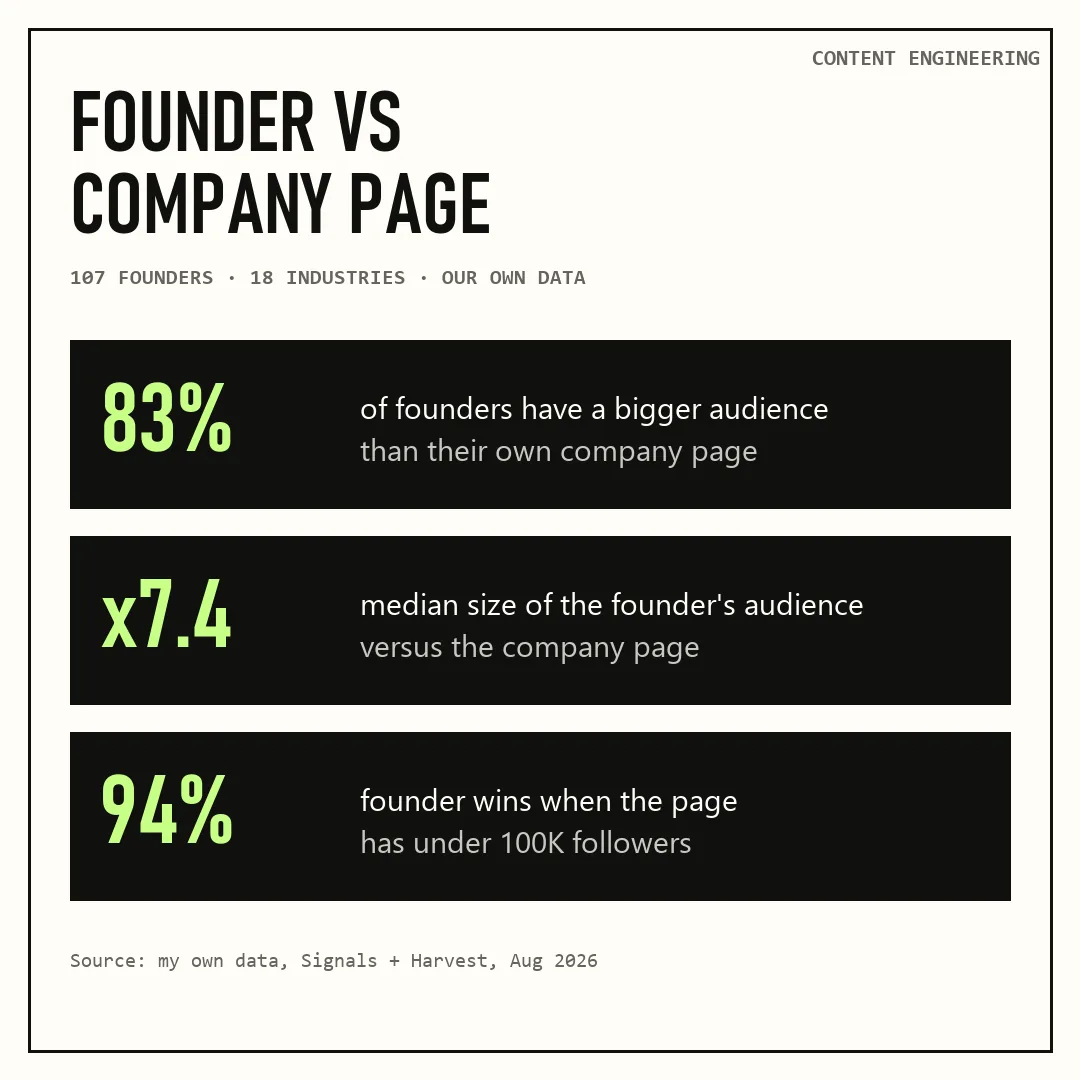
Out of 107 pairs, the founder has the bigger audience in 89 cases. That is 83 percent. The median founder walks into a room 7.4 times larger than the room his own company built.
The individual gaps are not subtle. Dennis R. Mortensen, a serial founder, has 487,621 followers. His current company, LaunchBrightly, has 569. Gary Travis has 732,279 against his company's 1,246. Matt Gray runs Founder OS with 6,578 page followers while his personal profile holds 901,759. Pascal Bouvier, a fintech VC, has 501,586 followers next to his fund's 4,156.
These are not celebrities borrowed from television. They are working founders and investors whose companies you may never have heard of, which is exactly the point. The company is small and quiet. The person is a media channel.
And the pattern holds down the entire list: a data consultant at ×194, a finance animator at ×181, a cybersecurity auditor at ×120. Different industries, same physics.
One more thing the data showed. The gap is not a lottery ticket, it correlates with work. Among founders who post four or more times a month, the median gap grows to ×7.8. Among those posting eight or more times, it reaches ×8.3, and 86 percent of them are ahead of their company. Showing up is the mechanism.
The gap, niche by niche
The pattern is easy to dismiss as a startup thing or a marketing thing, so here it is industry by industry: up to five pairs from each niche in the sample, founder first, their company's page second, sorted by the size of the gap.
| Founder | Followers | Company page | Followers | Gap |
|---|---|---|---|---|
| Data | ||||
| Megan Lieu | 210,179 | ML Data | 209 | ×1006 |
| Vin Vashishta | 208,236 | V Squared | 1,072 | ×194 |
| Khuyen Tran | 111,871 | CodeCut | 593 | ×189 |
| Avery Smith | 153,197 | Data Career Jumpstart | 9,637 | ×16 |
| Ian K. | 126,413 | Analyst Hive | 10,793 | ×12 |
| Startups | ||||
| Dennis R. Mortensen | 487,621 | LaunchBrightly | 569 | ×857 |
| Elfried Samba | 415,110 | Butterfly Effect | 8,158 | ×51 |
| Rahul Pandey | 138,029 | Maven | 48,904 | ×3 |
| Viraj Sheth | 202,612 | Monk-E | 97,592 | ×2 |
| HR | ||||
| Gary Travis | 732,279 | Tellstone | 1,246 | ×588 |
| Dominick Namis | 167,894 | NeoPeople | 2,896 | ×58 |
| Roberta Storey | 1,051,008 | Storeyline Resumes | 20,072 | ×52 |
| Jerry Lee | 418,277 | Wonsulting | 118,388 | ×4 |
| Janice Bryant Howroyd | 158,858 | ActOne Group | 45,691 | ×3 |
| Cybersecurity | ||||
| Isaac Faber Ph.D. | 131,366 | Pretorin | 246 | ×534 |
| Troy Fine | 39,377 | Fine Assurance | 328 | ×120 |
| KK Mookhey | 38,991 | Transilience AI | 899 | ×43 |
| Troy Hunt | 62,881 | Have I Been Pwned | 9,131 | ×7 |
| Jon Sakoda | 35,894 | Decibel Partners | 5,930 | ×6 |
| Venture Capital | ||||
| Guillermo Flor | 229,041 | MARKET FIT | 437 | ×524 |
| Vincent Granville | 198,618 | BondingAI | 1,494 | ×133 |
| Codie A. Sanchez | 554,161 | Contrarian Thinking | 12,220 | ×45 |
| Igor Buinevici | 328,507 | Wild Capital Academy | 11,453 | ×29 |
| Dan Murray | 222,356 | Heights | 12,404 | ×18 |
| Finance | ||||
| Nathan Hirsch | 81,968 | CFO Expertise | 164 | ×500 |
| James Eagle | 195,914 | Eeagli | 1,080 | ×181 |
| Vikram Mansharamani | 84,219 | Goodwell Foods | 554 | ×152 |
| Josh Aharonoff, CPA | 479,451 | Model Wiz | 7,751 | ×62 |
| Andrew Gazdecki | 115,194 | Acquire.com | 39,581 | ×3 |
| AI | ||||
| Hasanpreet Singh Toor | 170,556 | The ProHuman | 469 | ×364 |
| Tiffany Janzen | 42,866 | TiffinTech | 2,110 | ×20 |
| Lucy Wang | 80,932 | Zero To Cloud | 6,249 | ×13 |
| Roni Rahman | 185,643 | Cyberman AI | 15,186 | ×12 |
| Sumit Mittal | 316,127 | TrendyTech | 58,104 | ×5 |
| Media | ||||
| Harun Momanyi | 29,329 | Tranquil Media Group | 210 | ×140 |
| Robert Reich | 327,527 | Inequality Media Civic Action | 2,416 | ×136 |
| Steven Bartlett | 3,091,930 | Steven.com | 59,423 | ×52 |
| Kaya Yurieff | 18,552 | Scalable Pod | 1,974 | ×9 |
| Sibel Terhaar | 578,258 | LeadershipUp Magazine | 73,785 | ×8 |
| Marketing | ||||
| Matt Gray | 901,759 | Founder OS | 6,578 | ×137 |
| Jade Bonacolta | 473,267 | The Quiet Rich | 13,180 | ×36 |
| Neil Patel | 798,321 | Neil Patel Digital | 102,517 | ×8 |
| Fintech | ||||
| Pascal Bouvier | 501,586 | MiddleGame Ventures | 4,156 | ×121 |
| Sarah Guo | 133,745 | Conviction | 12,693 | ×11 |
| Alex Johnson | 25,386 | Fintech Takes | 3,066 | ×8 |
| Sheila Lirio Marcelo | 39,361 | Ohai.ai | 5,667 | ×7 |
| Dr Miquel Noguer i Alonso | 45,488 | Artificial Intelligence Finance Institute - AIFI | 9,484 | ×5 |
| Design | ||||
| Karla Fernandes (Team of One) | 18,188 | Vitamina K | Digital Products | 172 | ×106 |
| Aastha Sachdeva | 11,703 | Owle Studio | 2,235 | ×5 |
| Karine Hsu | 13,803 | Slope | 5,465 | ×3 |
| Tech | ||||
| Anupam Mittal | 1,628,604 | Shaadi.com | 83,062 | ×20 |
| Demis Hassabis | 239,206 | Google DeepMind | 103,270 | ×2 |
| Robert F. Smith | 238,488 | Vista Equity Partners | 214,878 | ×1.1 |
| Web Development | ||||
| Anthony Sistilli | 11,731 | Nightmarket.ai | 635 | ×18 |
| Cam Trew | 15,805 | Kleo | 14,368 | ×1.1 |
| Biotech | ||||
| Ashley Moses | 26,916 | PhD Paths | 1,457 | ×18 |
| Legal | ||||
| Katya Stelmakh | 11,648 | Stelmakh and Associates Business Immigration Law Firm | 954 | ×12 |
| Education & Training | ||||
| Sean McPheat | 222,362 | MTD Training - Leadership, Management & Sales | 29,884 | ×7 |
| Mark Ritson | 235,739 | MiniMBA | 75,500 | ×3 |
| Christian Wattig | 119,232 | Wharton Online | 74,303 | ×1.6 |
| Vishen Lakhiani | 151,688 | Mindvalley | 114,058 | ×1.3 |
| Automotive | ||||
| Vikas Gupta | 55,779 | Sampoorn EV Limited | 7,584 | ×7 |
| Aerospace | ||||
| Chad Anderson | 33,719 | Space Capital | 20,614 | ×1.6 |
These 63 pairs are the showcase: founders who are ahead, up to five per industry. The percentages above were computed on the full set of 107, losers included. Note the bottom entries in each group too: even where the gap narrows to two or three times, it almost never flips.
The second metric: what a month of posts shows
Audience size could be an old inheritance, a founder who built a following years ago and coasts on it. So we took 35 pairs where the founder actively posts and measured a month of original posts on both sides: how often each channel published and what a single post collected in reactions and comments.
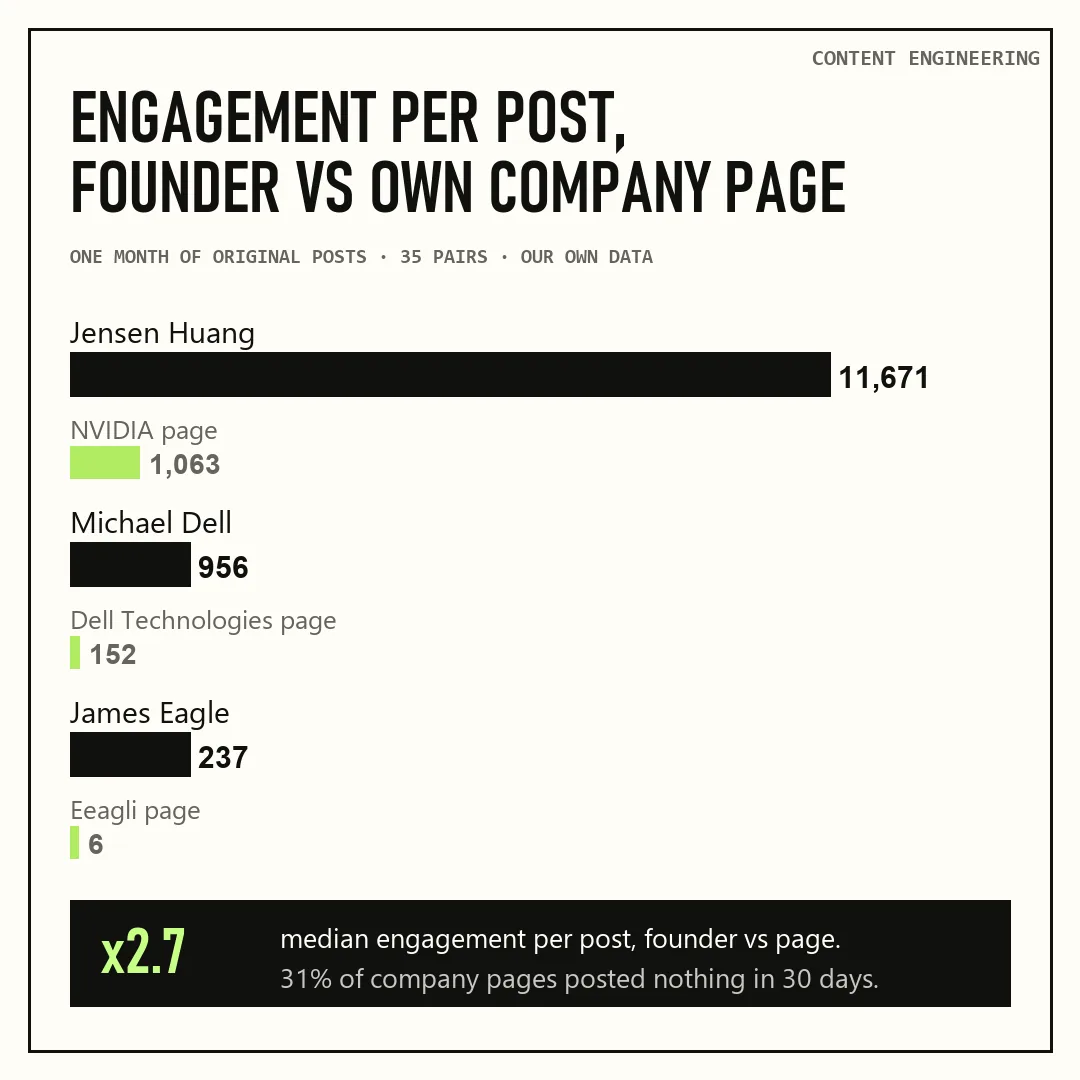
The first finding arrived before any comparison: 11 of the 35 company pages published nothing at all in thirty days. Not less, not worse. Nothing. A third of these companies maintain a channel that is technically alive and practically silent, while their founder posts weekly.
Among the pairs where both sides actually published, the founder's average post collects 2.7 times more engagement than a post from his own company's page. Same business, same news to draw from, and the face still beats the logo on a per-post basis.
Here is what a month looks like, founder versus his own company's page, average engagement per original post. Every name here is new, nobody repeats from the list above:
| Founder | Per post | Company page | Per post | Note |
|---|---|---|---|---|
| Zander Whitehurst | 900 | Memorisely | 242 | The page published more than twice as often. |
| Leila Hormozi | 706 | Acquisition.com | 191 | Across 45 posts. |
| Jerry Lee | 159 | Wonsulting | 37 | |
| Vishen Lakhiani | 115 | Mindvalley | 19 | The page posted more often. |
| Sumit Mittal | 102 | TrendyTech | 22 | |
| Neil Patel | 91 | NP Digital | 22 | A marketing agency with his own name on the door. |
| KK Mookhey | 89 | Transilience AI | 7 | 89 from 6 posts against 7 per post out of 7. Same company, same month, thirteen times the response. |
| Mark Ritson | 81 | Mini MBA | 44 | |
| Suresh Sambandam | 34 | Kissflow | 17 | The page posted more than twice as often. |
| Jason Yanowitz | 34 | Blockworks | 14 |
Notice the pattern inside the pattern: several of these pages post more often than their founders and still lose by multiples. Frequency is not the lever. The face is the lever.
So the ×7.4 audience gap is not a museum piece. Post by post, month by month, the person out-earns the brand.
Per post, the face wins again
Why people beat logos
The psychology is old and boring, which is why it is reliable: people follow people. A face in the feed gets read as a person talking. A logo in the feed gets read as an ad, and thirty years of the internet trained everyone to scroll past ads.
The platform mechanics point the same way. Industry analyses of LinkedIn reach (these are practitioners' numbers, LinkedIn publishes nothing) consistently find that posts from personal profiles travel several times further than identical posts from company pages. The algorithm favors what users prefer, and users prefer humans.
There is also a structural reason nobody mentions. A company page can only speak in one voice, the official one. Every sentence is written as if legal might read it. A founder can say that a launch failed, that a client fired them, that they changed their mind. That range is what makes an account worth following, and a page is not allowed to have it.
Two channels, two jobs
When the logo wins
The honest part of the data: 18 founders in our sample are behind their company page, and the pattern among them is impossible to miss.
Jensen Huang has 648,282 followers, which would make him a giant in any list, and NVIDIA has 6.2 million, ten times more. Michael Dell holds 1.9 million against Dell Technologies at 5.6 million. OPSWAT, a cybersecurity vendor with two decades of enterprise history, beats its founder roughly four to one.
Look at the threshold, though. Among company pages under 100,000 followers, the founder wins 94 percent of the time. The logo only reliably beats the face when the brand itself has become a household name with thousands of employees sharing its content.
And here is the twist our per-post measurement added: even at that scale, the face keeps winning attention. NVIDIA's page has ten times Jensen Huang's audience, yet his average post collects 11,671 reactions against the page's 1,063, eleven times more. Michael Dell averages 956 per post; Dell Technologies, with a page three times his size, averages 152. The logo can out-collect followers when the brand is planetary. It still cannot out-earn attention per post against its own founder.
If your company is at NVIDIA's scale, congratulations, you can stop reading. Everyone else is on the wrong side of the 94 percent when they route their content through the page.
The routing rule
So the channels are not rivals, and picking one is the wrong question. They do different jobs, and a content system assigns each job explicitly.
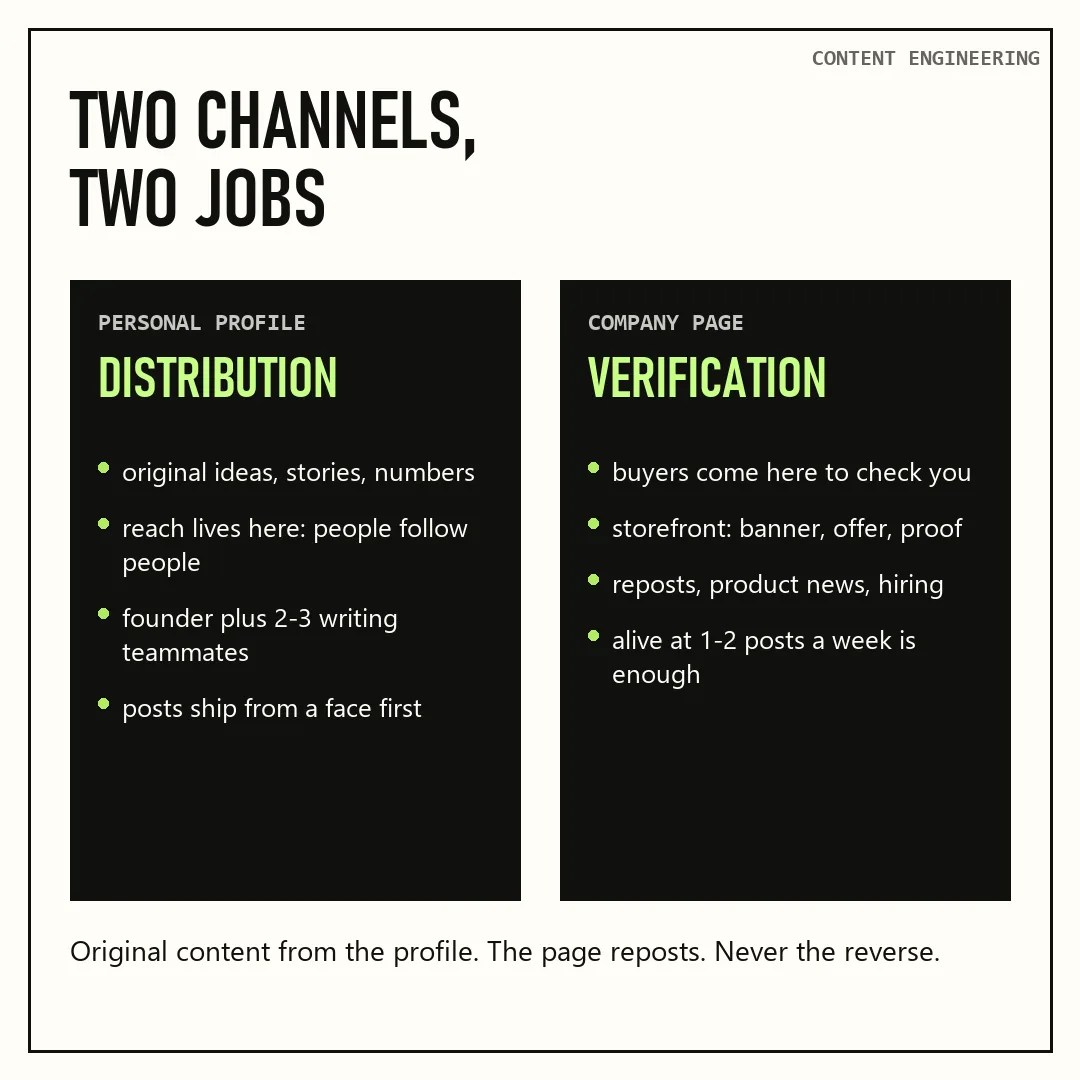
The personal profile is the distribution channel. Ideas, stories, numbers, opinions, everything that needs to reach people ships from a face: the founder first, and ideally two or three more writing people from the team, because several profiles compound into a network the way one never can.
The company page is the verification channel. Nobody discovers you through it, but almost every serious buyer checks it. Someone reads the founder's post, gets curious, clicks the company, and decides in ten seconds whether this is a real business: recent activity, clear positioning, team, product. The page does not need reach. It needs to not fail the inspection.
The order of operations follows from the jobs. Original content goes out from the profile. The page reposts selected profile posts, adds product news, case studies and hiring, and stays visibly alive at one or two posts a week. Employees repost from their own accounts when it is natural. Never the reverse: pushing original content through the page first and having the founder repost it flips the physics upside down and wastes the larger room.
The Playbook: route your next month
- Count both rooms today. Your followers, your page's followers. If you are the median founder from our data, your room is seven times bigger. Act like it.
- Move original content to profiles. Whatever the company wanted to say this month, a person says it. The page can repost within a day.
- Rebuild the page as a storefront, one hour, once. Clear banner, plain description of what you sell, pinned proof. Then keep a light pulse: one or two posts a week, reposts count.
- Add writing teammates. Two or three people posting twice a week from their own profiles beat any page budget. Different voices, same direction.
- Recheck in 90 days. Compare inbound conversations, not impressions. Rooms are means; conversations are the point.
Closing
The company page was never the problem, and it does not need to be abandoned. It was just hired for the wrong job. Distribution belongs to faces, verification belongs to the logo, and a content system is exactly this kind of unglamorous decision made explicit, measured, and repeated.
Next issue: we open our own books and count what a month of running content on agents costs, model by model, including the spend that turned out to be a waste.
Serge
P.S. If your company posts three times a week into a page with 400 followers, forward this issue to whoever owns that calendar. The 94 percent will do the arguing.
Content Engineering is a newsletter by cccrafts. We build and run content systems for B2B companies. That is our bias, factor it in. DM Serge at linkedin.com/in/sbulaev if you want the routing done for you.
Serge Bulaev is the CEO and founder of cccrafts, where the team builds and runs content systems for B2B companies. He writes Content Engineering, a newsletter about the data, automations and costs behind content that reaches the right buyers.