
How B2B Founders Find Clients on LinkedIn in 2026
I ran my own LinkedIn as a lab: three posts a week, daily outreach, every touch logged. The posts got likes, the pipeline stayed empty. Here is the number.

Everyone will tell you the answer is posting more. I turned my own LinkedIn into a lab to check: three posts a week, hundreds of daily interactions, every touch logged into a CRM. The posts collected likes. The pipeline stayed empty. Then we found the number that explained everything. This issue is about that number, and about the system that finds clients where posts alone can't.
First, an honest note about this newsletter. It used to be called LinkedIn Heroes, and it taught LinkedIn tactics to people who love LinkedIn. The problem: the people who love LinkedIn tactics are mostly marketers and writers. The people we work with are founders, and founders have a different question. They don't ask how to write a better post. They ask why content should get a single hour of their week at all.
This first issue under the new name answers that question with my own numbers, including the embarrassing ones.
Here is the short version. This year I handed my profile to my team and we ran it as a controlled experiment. Everything was measured. And the single most important thing we found was not in any post's statistics. It was in the gap between two lists of names that were supposed to overlap, and didn't.
In this article
- If you only have 60 seconds
- What changed: writing got free, attention got priced
- The number that made us rebuild everything
- What the system around content looks like
- The A/B test we didn't plan
- The Playbook: five questions to test your own setup
- Do this this week
- Closing
If you only have 60 seconds
Generating a post costs nothing in 2026, so a post by itself is worth almost nothing. Feeds are flooded, and readers have a working radar for machine-written filler.We compared 245 people I touched through daily outreach with 65 people who engaged with my posts in the same two weeks.The overlap was zero.My own data.Posts and outreach behave like two separate companies unless something connects them. That connecting layer is what we call content engineering.A content system has five parts: an audience map, content in the author's voice, daily engagement, outreach to people who responded, and a log that ties it together.The one post that reached the right audience was the one the data picked, and it outperformed my well-written personal story by every measure that matters.
- Generating a post costs nothing in 2026, so a post by itself is worth almost nothing. Feeds are flooded, and readers have a working radar for machine-written filler.
- We compared 245 people I touched through daily outreach with 65 people who engaged with my posts in the same two weeks. The overlap was zero. My own data.
- Posts and outreach behave like two separate companies unless something connects them. That connecting layer is what we call content engineering.
- A content system has five parts: an audience map, content in the author's voice, daily engagement, outreach to people who responded, and a log that ties it together.
- The one post that reached the right audience was the one the data picked, and it outperformed my well-written personal story by every measure that matters.
What changed: writing got free, attention got priced
For fifteen years the hard part of content was making it. You needed someone who could write, an editor, a calendar, discipline. Companies that shipped three decent posts a week stood out because most companies couldn't.
That advantage died quietly over the last two years. Any founder with a laptop can now generate thirty posts before breakfast. So everyone did. The result is a feed where the supply of words exploded while the supply of reader attention stayed exactly the same.
Two consequences follow, and both are measurable.
The first is that readers built a filter. People now pattern-match machine-written text in about two lines: the rhythm, the fake profundity, the bullet points that say nothing. Industry analyses of LinkedIn's 2026 ranking engine (not official LinkedIn numbers) put the penalty at roughly 30 percent less reach and half the engagement for text that reads as generated. The platform itself reads posts semantically now. It ranks meaning, and thin meaning sinks.
The second consequence is stranger and more important. When everyone can produce content, production stops being the bottleneck. The bottleneck moves to a question that most companies cannot answer: who exactly should read this, and will they ever see it?
That question has nothing to do with writing. It's a data problem and a distribution problem. In other words, an engineering problem.
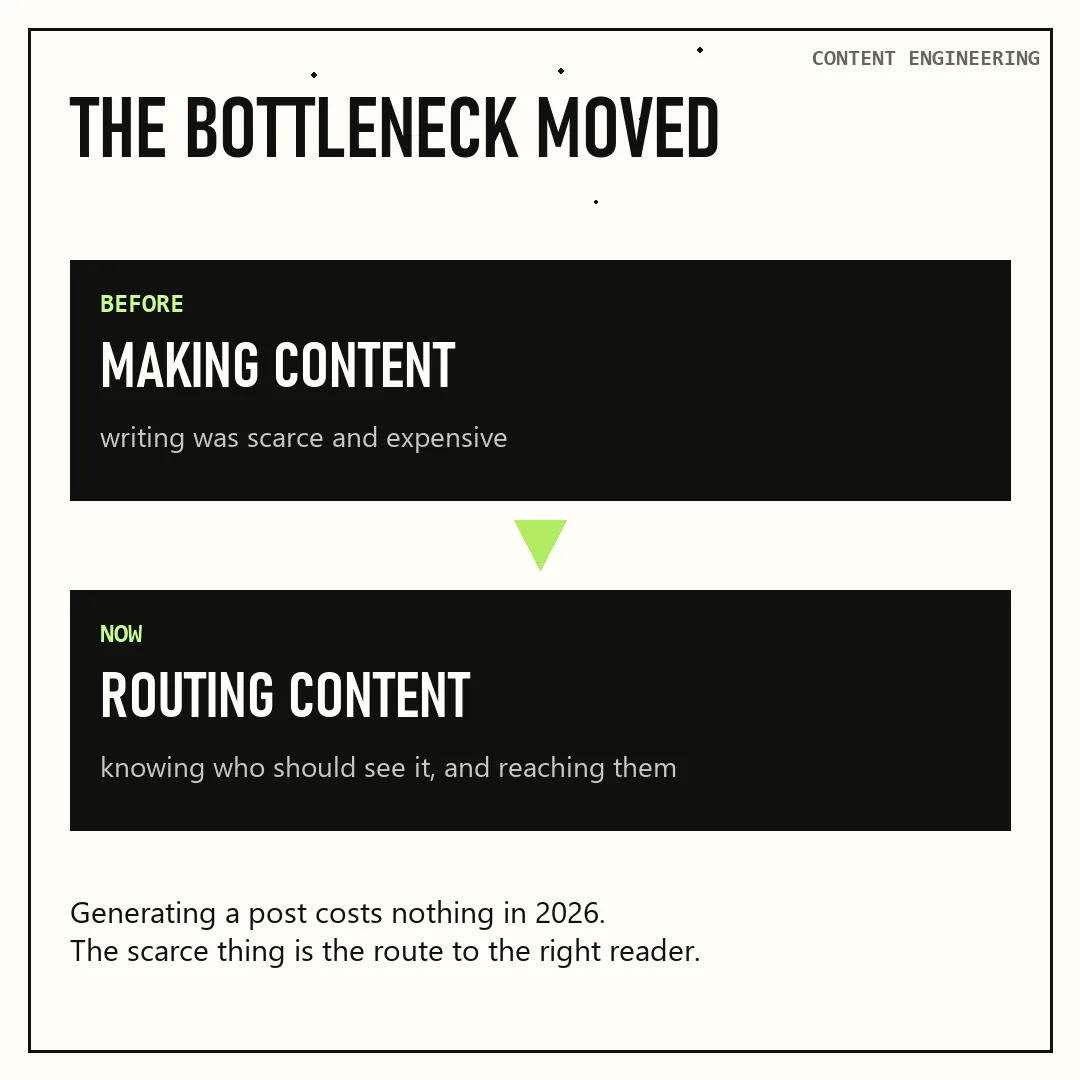
The bottleneck moved from making content to routing it
The number that made us rebuild everything
Now the experiment. This is my own data, from running my LinkedIn as a live lab: three posts a week, plus a daily engagement routine where my account touched other people's posts with likes and comments, plus outreach. Every interaction was logged. It's the same setup my team runs for clients, with one difference: my numbers get published.
After two weeks we pulled two lists.
List one: everyone I had touched outbound. 460 interactions across 245 unique people, 80 percent of them founders and C-level, matched against a target list of the exact people I wanted as clients.
List two: everyone who engaged with my posts in the same period. 65 people liked or commented.
Then we intersected the lists, expecting to see the machine working: you warm someone up with comments, they start reading you, the relationship compounds.
The intersection was empty. Zero names on both lists.
The people I was building relationships with never saw my content. The people who saw my content were strangers to my pipeline.
Sit with how bad that is. Both activities looked healthy on their own. The posts got a thousand views each, normal for a profile my size. The outreach hit its daily numbers. Any dashboard would have shown green. And the two halves of the operation were not touching at all, because nothing forced them to touch.
We checked who my 65 readers were. Mostly writers, marketers, and freelancers, the people who follow content about content. Of the people who engaged, the largest useful group came from one single post, which I'll get to below. The rest of the audience was applauding from the wrong room.
A post is not a system. A post is a flare fired into the sky. Whether the right people are standing under it is decided by everything around the post, and if you don't build that "around," the default answer is no.
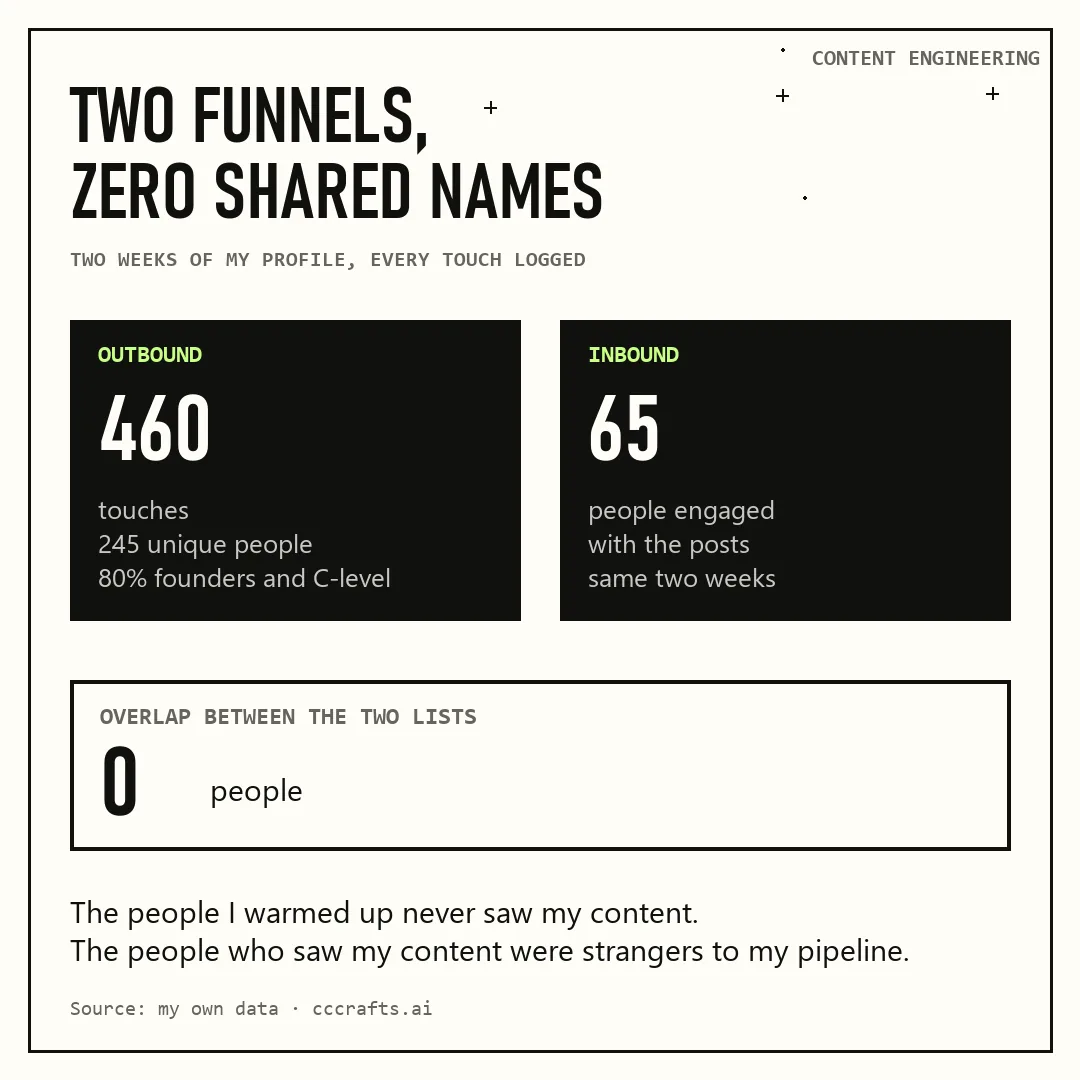
Two funnels, zero shared names
What the system around content looks like
Content engineering is the discipline of building that "around." The term sounds grand, but the machine has only five parts, and each one answers a plain question.
1. The audience map: who should see this?
Before anyone writes a word, you need to know who the buyers are and, more usefully, whose content those buyers already read. This is knowable. We track thousands of B2B authors daily and map who engages with whom. When we ran 100 target founders through this, the median one interacted with somebody else's post 3 times a day. They are in the feed. The question is whose feed, and the answer is specific names, not demographics.
2. Content in the author's voice: what do we say?
The post itself still matters, and one thing decides its fate more than any writing technique: whether it contains something only you know. Our July analysis of 316 top-performing LinkedIn posts (pulled from our Signals database) showed the same pattern over and over: one concrete number in the first line, internal data instead of public studies, material worth saving. The author approves every word before it ships, because the reader's slop radar is the one filter you cannot engineer around.
3. Daily engagement: why would they ever look at us?
People read people who show up in their world. A like and a thoughtful comment on a buyer's post is a small, honest way to appear there. Done daily, across a mapped list, it compounds. Done randomly, it produces exactly what our experiment produced: warmth aimed at one crowd, content aimed at another.
4. Outreach to responders: what happens after they react?
When someone from the target list likes a post or replies to a comment, that's a signal, and signals decay in days. The system's job is to catch it and turn it into a conversation while it's alive. This inverts cold outreach: you message people who already moved toward you.
5. The log: how do we know any of this is working?
Every touch, in and out, lands in one place (we use a CRM, a customer database, for this). This is the part nobody enjoys and the part that found our zero-overlap problem. Without the log we would still be admiring the two green dashboards.
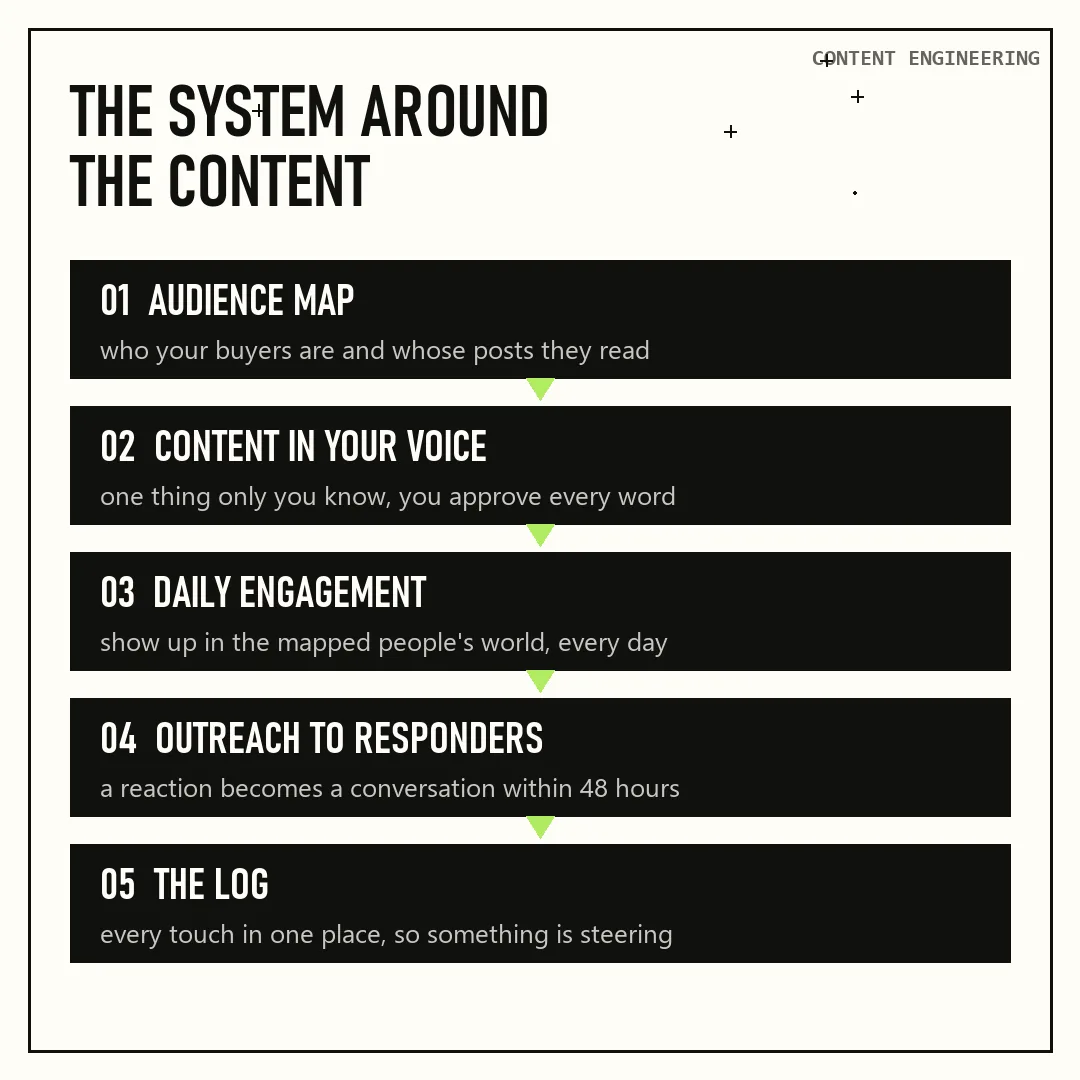
Five parts, one machine
None of these parts is exotic. What makes it engineering is that they run on data and run every day, whether or not anyone feels inspired. The founder's job shrinks to two verbs: approve and talk.
The A/B test we didn't plan
The clearest proof came from comparing two of my posts from the same stretch of the experiment.
Post A was my personal story, well written by any standard, about a childhood notebook and the lessons behind the media business I grew to 30 million readers. It gathered decent likes, one comment, and an audience of hired managers. Zero investors, zero founders in the engagement.
Post B was picked by the data. We used our tracking to rank investors by how often they engage with other people's posts, and I published the list of the 30 most active ones, with numbers. The post pulled 12 investors and 12 founders into the comments and reactions, 10 real comments, and people sharing it forward. It was the only post of the whole experiment whose audience matched my target list.
Same me, same profile, same week. The difference was that Post B started from the audience map instead of from inspiration. It gave a specific, verifiable, useful thing to a specific room of people, and the right room showed up.
One post like that doesn't fill a pipeline. But it demonstrated the mechanism: when the data picks the topic, the audience stops being an accident. And to be straight about the bias here: this is the system my team sells and runs for clients. My profile is the unit we test in public, so the numbers you read are the ones we live with.
The Playbook: five questions to test your own setup
You don't need our stack to check whether you have a system or a hobby. Five questions, honest answers:
- Can you name 20 specific people you want reading your content? Names, not personas. If not, you have no map.
- Do you know whose posts those 20 people engage with? That list of authors is the actual arena you compete in.
- Did your account meaningfully touch any of the 20 this week? A comment they saw counts. A post they never saw doesn't.
- When one of them reacts to anything you do, does something happen within 48 hours? If a reaction just sits there, you're collecting signals and burning them.
- Can you pull the list of every target-list person your content reached this month? If the answer takes longer than five minutes, nobody is steering.
Five yes answers means you're running a system, whoever built it. Two or fewer means your content is a lottery ticket with good typography.
Do this this week
- Write down the 20 names. One hour, no tools needed.
- Check the overlap by hand: scroll the likers of your last five posts against those 20 names. Prepare for the number to be zero. Ours was.
- Pick your next topic from data you already own: your pricing history, your churn reasons, your tooling costs. One concrete number in the first line.
- Comment on posts by five people from your list. Real sentences, no emoji applause.
Closing
Posting into the feed and hoping is over as a strategy. The companies getting clients from content in 2026 are running machines: quiet, daily, measured. The post you see is the visible ten percent.
We rebuilt this newsletter to document that machine from the inside: the automations, the costs, the data, including everything that fails. Next issue: we opened our own books and counted what a month of running agents costs, model by model.
You already know how to write. The question is whether anything is steering.
Serge
P.S. If a founder you know is proud of their posts and quiet about their pipeline, forward them this issue. The five questions above will do the rest.
Content Engineering is a newsletter by cccrafts. We build and run content systems for B2B companies. That's our bias, factor it in. DM Serge at linkedin.com/in/sbulaev if you want the five parts running for you.
Serge Bulaev is the CEO and founder of cccrafts, where the team builds and runs content systems for B2B companies. He writes Content Engineering, a newsletter about the data, automations and costs behind content that reaches the right buyers.