
Which B2B Buyers Are Actually Reachable on LinkedIn in 2026?
We measured 10,000 people: who comments on LinkedIn, how often B2B buyers answer strangers, and how to build a reachable buyers list instead of cold outreach.

Every company I work with here in the States has an ICP, a list of the companies it wants as customers. We break those companies down into people, pull out the decision makers, and that list becomes the top of the funnel. Then most of the people on it never answer.
Think about what outreach asks for. You write a message and hope that at this exact moment the person is in pain, and that they see the message at all. Both chances are small. I wrote one CMO three letters in two weeks and did not get a single answer, and nobody can tell me whether that silence means "not interested" or "never saw it".
Every touch costs money, ads are expensive and practically impossible to target by person, and nobody tells you the one thing that would settle the budget: which names on the list are reachable at all.
Here is what the numbers look like when you pull a list out of a contact database. Ten thousand people come out, and usually about three thousand of them are active anywhere, sometimes two. Of the ones on LinkedIn, roughly 10 to 25% write anything themselves. And roughly half of those engage with other people's posts.
All of that is public on the profile, unless the person has specifically hidden it. Every comment, every like. Not everyone knows this.
So this issue is about one question you can ask of any person on your list: how often do they comment under other people's posts? Not whether they want to buy, only whether they are in public, reading, and willing to answer a stranger. We measured that for about ten thousand people across three datasets, and by the end you will know:
- what share of a typical list is reachable this way
- how the same number looks for real buyers and for whole GTM teams
- the exact steps to sort your list into three buckets, each with its own play
The idea came out of a post. Two weeks ago I published a ranking of CMOs by how many comments they leave a month, and we had never had a post like it. People asked why they were not on it. Two CMOs from companies I did not know wrote comments, I connected with them, and I have calls coming.
The replies all asked the same thing: fine, but how do I get to these people? This is the long answer.
We are selling our services, so to speak. We don't sell outreach, we sell touchpoints. Factor that in.
In this article
- What a comment costs
- Layer one: who is under your own posts
- Layer two: the buyers themselves
- Layer three: whole teams
- The one number all three layers agree on
- The system, step by step
- The list was never the asset
What a comment costs
There is a ladder of attention on LinkedIn, and each step costs the person more. Followers say nothing at all. A like is already good, even a like gives pleasure, but the number of likes is a vanity metric and one like is not equal to another. Then comes a comment, which is another level entirely, then a connection, and then a message, the highest level of all.
Comments are a great rarity. Comments are scary, because in a comment there is even more human communication. Everyone still reviews which comments will go out, because it is scary to write who knows what to people, and for top managers it is not proper to like and comment on everyone in a row.
A comment requires a person to read, form an opinion, and put their name next to it in public, and the feed ranks it far above a like.
That price is the point. If someone pays it regularly, public conversation is part of their job. The texts are only 30% of the matter. The rest is engagement: whom you like, whom you comment on, how many comments you write a day.
So instead of asking "who is my buyer" I started asking which of my buyers pay this price, and where.
We looked at that from three angles, with three separate datasets collected under different rules. Compare the percentages inside each layer, never across layers.
Layer one: who is under your own posts
We track about 60 thousand people on LinkedIn every day and save all their posts, so we can run research on the base itself. In August we pulled every reaction and comment under 258 posts from 26 marketing leaders, plus my own feed: 7,381 people, each sorted by job title.
A quarter of them hold a buying title, C-level or VP and above, after removing people who sell services. Another 21% sell services themselves.
Sorted by what they did, from the cheapest action to the most expensive:
- 78% only liked something
- 19% wrote at least one comment
- 2.4% came back into a thread and continued the conversation
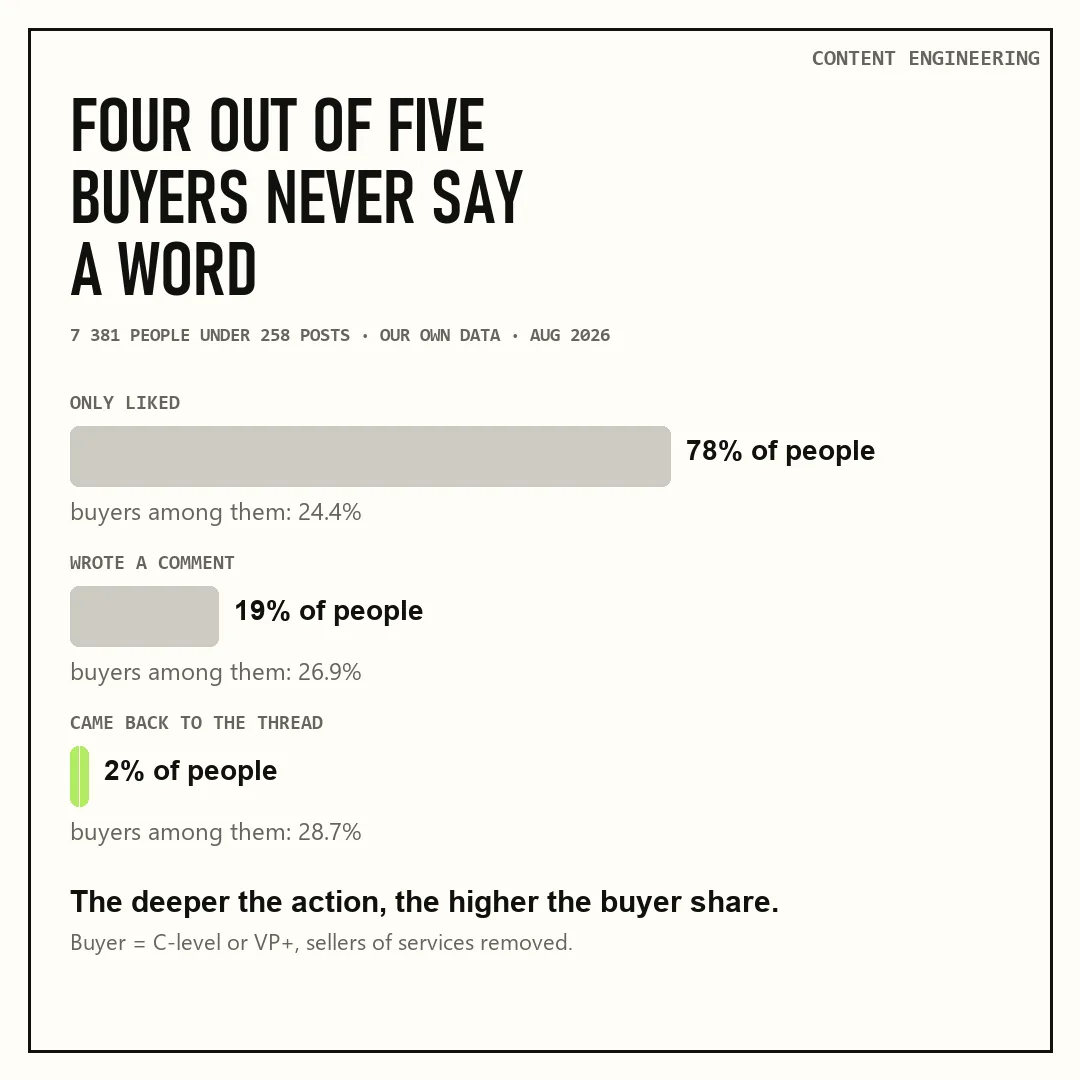
Three layers under 258 posts, sorted by the price of the action. Our own data, August 2026.
The buyer share climbs with every step, from 24% among the silent likers to 27% among commenters and 29% among the people who came back for a second reply. Sellers of services climb faster, from 19% to 29%, which is its own warning.
Very often people try to sell me services that I provide myself. Someone liked my post again just three minutes ago: "Helping B2B founders and companies build visibility." Why am I in the same niche with them? The comment section of a popular post is half buyers and half people trying to reach the same buyers.
A like still tells you something: the person saw you and chose you, and if that person is your potential buyer, the post was not in vain. One client opened three posts, pointed at 35 likes and said, only these three matter. A single active feed passes a median of 52 buyers a month, and 406 people with buying titles came back to two or more posts of the same author.
We took all of one client's engagers for a year, everyone who liked or commented on his posts, roughly 2,500 people. 780 of them worked in companies that are part of his ICP. And then the question: why did we do nothing with this? If a tenth of the people who come and like your posts are useful to you, some work with them has to continue.
Four out of five buyers never say a word. The ones who comment have already decided to talk in public, and that is the group worth knowing by name.
Layer two: the buyers themselves
Layer one tells you who comes to you. Layer two flips the camera and asks what the buyers do on everyone else's posts.
After the CMO post the list grew: a reader who tracks the press about CMO appointments shared his table, 850 CMOs with LinkedIn profiles, and we had 850 instead of 360. Of those, 359 published at least once in the last 30 days. We took the 195 most followed, excluding the 59 people I had already featured, and pulled every comment each of them left in the last 30 days.
These are CMOs who already write. Silent CMOs are not in this sample, so the shares below describe active marketing leaders, not marketing leaders in general.
What 195 publishing CMOs did in a month under other people's posts:
- 81% left at least one comment
- 41% left five or more
- 20% left ten or more
- ten people left thirty or more, and exactly one passed a hundred
- the median is 3 comments a month, the mean is 7
Some made hundreds, some made two.
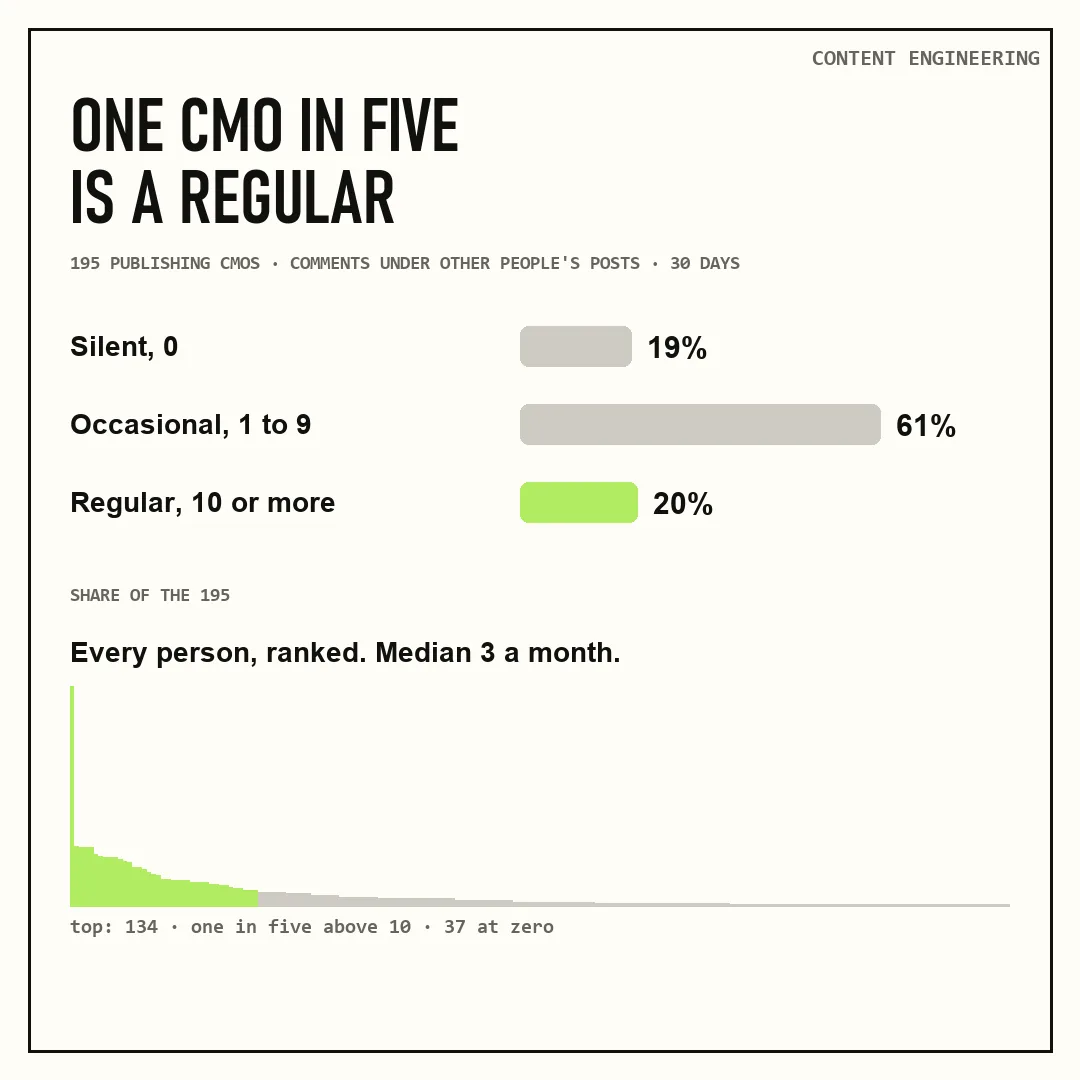
195 CMOs who posted in the last 30 days, ranked by comments under other people's posts. Our own data, September 2026.
Two things surprised me here.
First, follower count matters less than I expected. Followers, especially if you do not write, have almost no meaning. I know people with 50 followers who started writing and took off. It does not happen often, but it happens.
CMOs above 20,000 followers comment 94% of the time with a median of 5, CMOs under 5,000 comment 77% of the time with a median of 3. The gap is real but small. If you were filtering your list by audience size, you were filtering on a weak column.
Second, there is no watering hole. 1,363 comments went to 1,015 different authors. Only seven authors in the whole set received comments from three or more of our CMOs, and only 1% of the comments went to another CMO from our own base.
LinkedIn is all super algorithmic: however many people you follow, it shows you hundreds of them at best, so each of these CMOs reads their own small corner and answers there. I don't read the general feed myself, I read a list.
That kills one popular tactic and enables another. You cannot camp under one big account and wait for the CMOs to arrive. But we did not just count the quantity, we know whom they comment on.
I looked at whom one of them engages with, and found seven clients she supports and mentions in comments. And there are a thousand like her. For any one person on your list, the ten or twenty authors they actually answer is a short, stable list, and it can be pulled in a minute.
Layer three: whole teams
The first two layers looked at individuals who chose to be visible. The third looks at entire teams, with nobody self-selected.
A colleague told me whom he works with: Cursor, OpenAI and Anthropic, such and such positions. We looked, and the contact database showed 1,200 people at Anthropic, while LinkedIn showed 4,000. There are more than enough of them, it is just a question of pulling them out.
This time the pulling out started with a site I found by accident, transfer.ayautomate.com: a public directory of 87,608 people at 29 AI labs, with a filter by company and a filter by role, open, no login. I asked it for everyone in sales, growth, marketing and partnerships at OpenAI, Anthropic, Cursor, Perplexity and ElevenLabs. It returned 2,864 people. That is where the directory's job ended and ours began.
That is what we do: we convert companies into people, people into profiles, and then we start working with this. Our system:
- cross-checked the names against our own base and added 256 GTM people the directory had missed
- cleaned out everyone whose title said partner, volunteer, campus ambassador or recruiter
- pulled 30 days of comments for each remaining person
- verified the 200 most active against their live profiles, because a directory tells you who claimed to work somewhere, and a profile tells you who does
That left 2,773 people. Our own data from here on.
Share of each team that wrote at least one comment in a month:
- ElevenLabs, 277 people: 71%
- Cursor, now part of SpaceXAI, 330 people: 64%
- OpenAI, 1,111 people: 44%
- Perplexity, 42 people: 38%
- Anthropic, 1,013 people: 33%
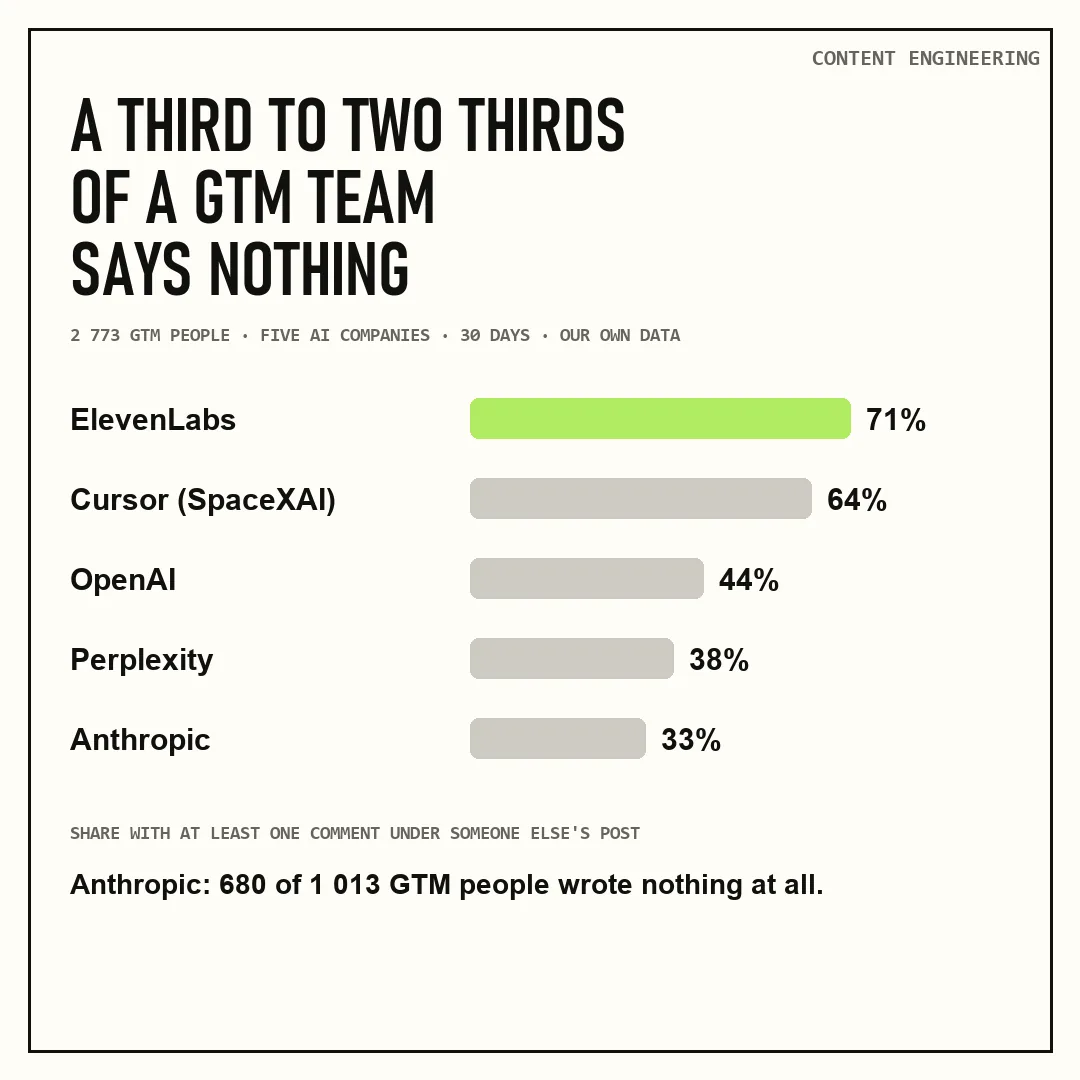
2,773 GTM people at five AI companies. Share with at least one comment under someone else's post in 30 days. Our own data, September 2026.
At Anthropic, 680 people whose job is to bring in customers did not leave a single public comment under anyone else's post in a month. That is not a criticism of the company. It is a map. If you are selling into that account, or hiring from it, or competing with it, two out of three people there will only be reachable through a cold channel, and one in three is already in conversation somewhere.
Then I looked at where those comments go. How does it usually happen inside a company? A top manager posts something, there is a special little chat, they post the link there, and people start liking. Many forget, many like late.
On paper 86% of all GTM comments went to authors outside the company. But the single most commented author among ElevenLabs GTM people is Ashley Kramer, their own Chief Revenue Officer, with 86 different colleagues under her posts, followed by Mati Staniszewski, their co-founder. Once you count the leadership and every employee we could identify, about a third of ElevenLabs GTM comments stay inside the company. At OpenAI and Cursor it is around one in ten, at Anthropic one in twenty.
That is a real difference in how teams behave. The top manager writes, the SDRs engage, and thereby all the accounts grow, because you amplify each other and because being alone is very hard. It works outside too: 61% of the ElevenLabs team answered someone external at least once, the highest of the five. Anthropic's team is quieter everywhere, but almost everything they do say goes outward.
The individual ranking is tight at the top: the most active person wrote 43 comments to strangers in a month, and the 25th wrote 16. The names are in this week's post, so I will not repeat them here.
The one number all three layers agree on
Different populations, different rules, one pattern.
- Under your posts, one person in five comments.
- Among buyers who write themselves, four in five comment but only one in five does it ten times a month.
- Inside whole teams, between a third and two thirds say anything at all, and between 1% and 9% are regulars.
Comments are a great rarity. The ones who pay that price are telling you, in public, every week, that they are open to a conversation.
The value of people is different. To some you can send a connection and not care that they did not answer, and others you will like for half a year in order to send a connection.
I used to think of a target list as a spreadsheet of titles. Now I think of it as three buckets, and the buckets are the strategy.
The silent bucket gets the cold sequence, because nothing else will reach it, and you have to admit that not everyone you outreach will connect with you anyway. The occasional bucket gets watched, and it is very important to prioritize the rare ones: if a person who writes rarely finally wrote, prepare a comment for them right away. The regular bucket gets met where they already are, under the posts they already answer, with something worth saying.
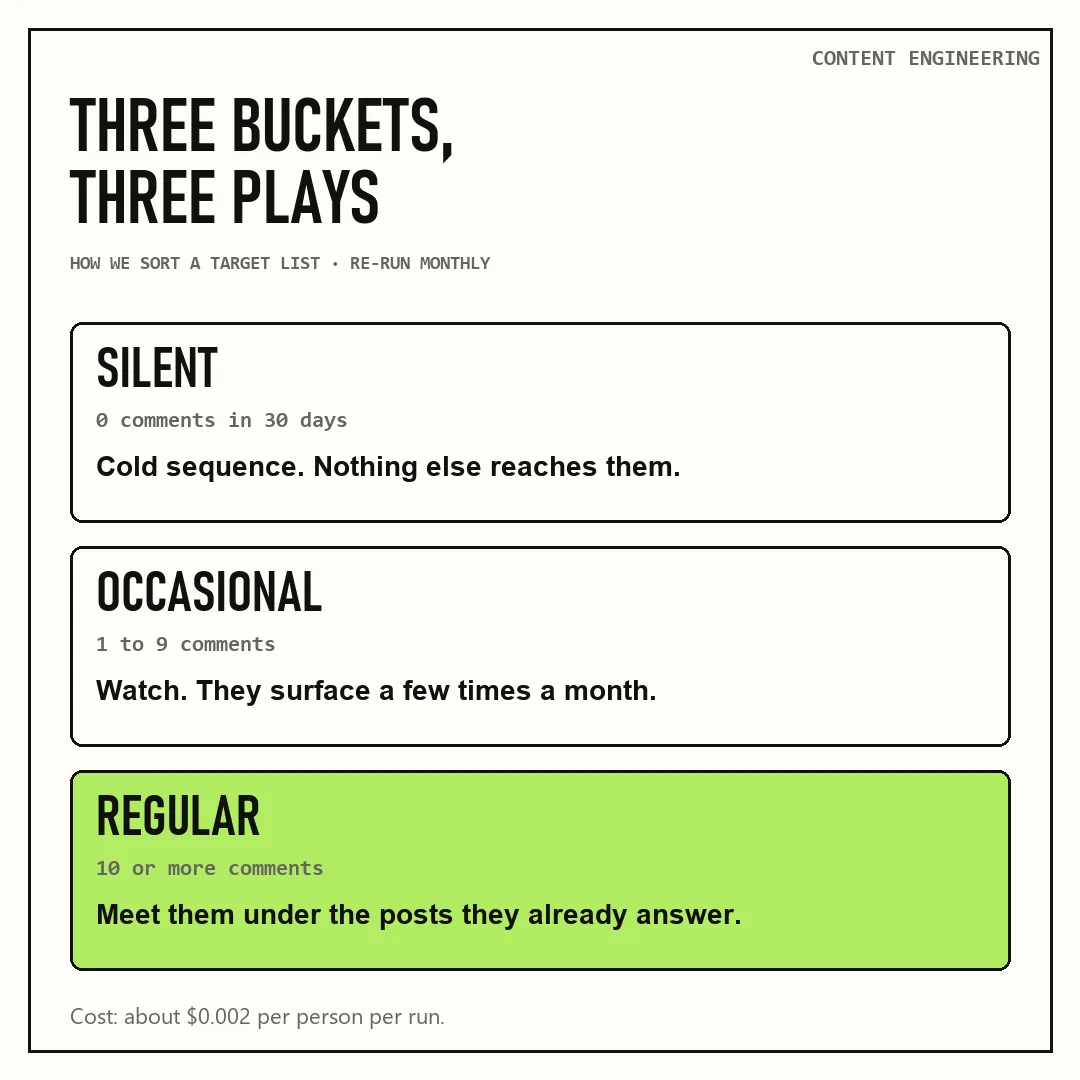
How we sort a target list. Re-run monthly.
The system, step by step
Here is what we now run for ourselves and for clients. Each step is boring on purpose.
1. Start from a list of named people, not titles.
It is not even a role model, it is literally people: in the end we get down to profiles on LinkedIn. We assemble the ICP with the client, who usually arrives with companies and positions. We will not look for 10 thousand right away, because it is expensive; a hundred to five hundred profiles that you would actually want on a call is enough to start.
2. Pull thirty days of comments for each person.
Open the profile, there is Activity, and there you can look not only at posts but at comments too. Press Show All and you can even see reactions, whom they liked. It is like that for everyone.
For ten or twenty names you do this by hand and for free: count what they wrote under other people's posts in the last month, and skip their replies under their own posts.
For a list of hundreds you need a data service, and every download costs money. A client once asked me, you understand that this costs money for each one? Well, you will spend one dollar. The one we use charges about $0.002 per person, so a 500-person list costs roughly a dollar per run. Save all of it, so that you do not request the same people twice.
3. Sort into three buckets.
Silent, zero comments. Occasional, one to nine. Regular, ten or more. In our data the regular bucket is 20% of publishing CMOs and 1% to 9% of a GTM team, so expect it to be small.
4. For the regular bucket, list the authors they answer.
Every person has their own ten to twenty. You can build it up layer by layer, who else likes the same founders, for example. There is no shared list, so do not look for one.
5. Show up there.
Reply to their comment, not to the post, and answer what they said: add a number they did not have, a case that agrees with them, or one that does not. No pitch, no link, no mention of your product.
You are trying to help the person. People love to help other people. People love to give advice. People love to teach. I love it myself. You keep thinking about what they will think of you, but most people want to be asked what they think. Not about you, about themselves.
You can send a connection request right away, or you can like a person for two months first and send it then, and the conversion differs very strongly: cold, maybe 10, maybe 20%; with warming we get 50 to 60%. Do this two or three times over a few weeks before you write to them directly. Cold outreach stays reserved for the silent bucket, where it is the only option.
6. Re-run monthly.
A person is not static. Someone is checked every day, someone once a week, someone once a month, depending on how often they post. A CMO who went quiet during a launch comes back; a new hire starts posting. The list is a living thing, and the cost of refreshing it is a dollar.
Two warnings. A comment is a reachability signal, not a demand signal. If a person corresponds with you, it does not mean that you have warm relations, they can forget you in a day. And the regular bucket is where every seller of services is also headed, as layer one showed, so what you say when you arrive matters more than arriving.
The list was never the asset
It is not the research that matters, it is the source data. I think the time of databases is coming again, or it was always like that.
For years I treated a target list as the finished product of research. Three measurements later I think the list is the raw material, and the asset is the split, and the proportions hold across audiences, buyers and teams measured under different rules, which is what makes me trust them.
In the end this is not just content, this is relations, we are selling relations. What is the problem? That relations are a long-term investment. I see it in my own business: in B2B sometimes a lead takes a year to come to you. I once sold by establishing a relationship with a champion on that side, and after half a year of warming he walked into the director's office at the right time.
So the question a marketing or sales leader should ask of a list has changed. It used to be "how many decision makers are on it". Now it is "how many of them are reachable, and where", and the answer decides the budget.
A customer asks me: who from our ICP liked the posts you wrote? For me this is already a business metric. Every name in the silent bucket is a cold-channel cost. Every name in the regular bucket is a conversation that already has a place and a time, and the only thing missing is you with something worth saying.
All comments, all likes, they are all public. Count them before you count anything else.
We run this split for our clients as part of the content systems we build, and we run it on my own list every month. I tell everyone the same thing: let's have a call, I will show you what to do. Write to me at linkedin.com/in/sbulaev or through cccrafts.ai, and we will talk about your list and what it would take.
Content Engineering is a newsletter by cccrafts. We build and run content systems for B2B companies.
Serge Bulaev is the CEO and founder of cccrafts, where the team builds and runs content systems for B2B companies. He writes Content Engineering, a newsletter about the data, automations and costs behind content that reaches the right buyers.